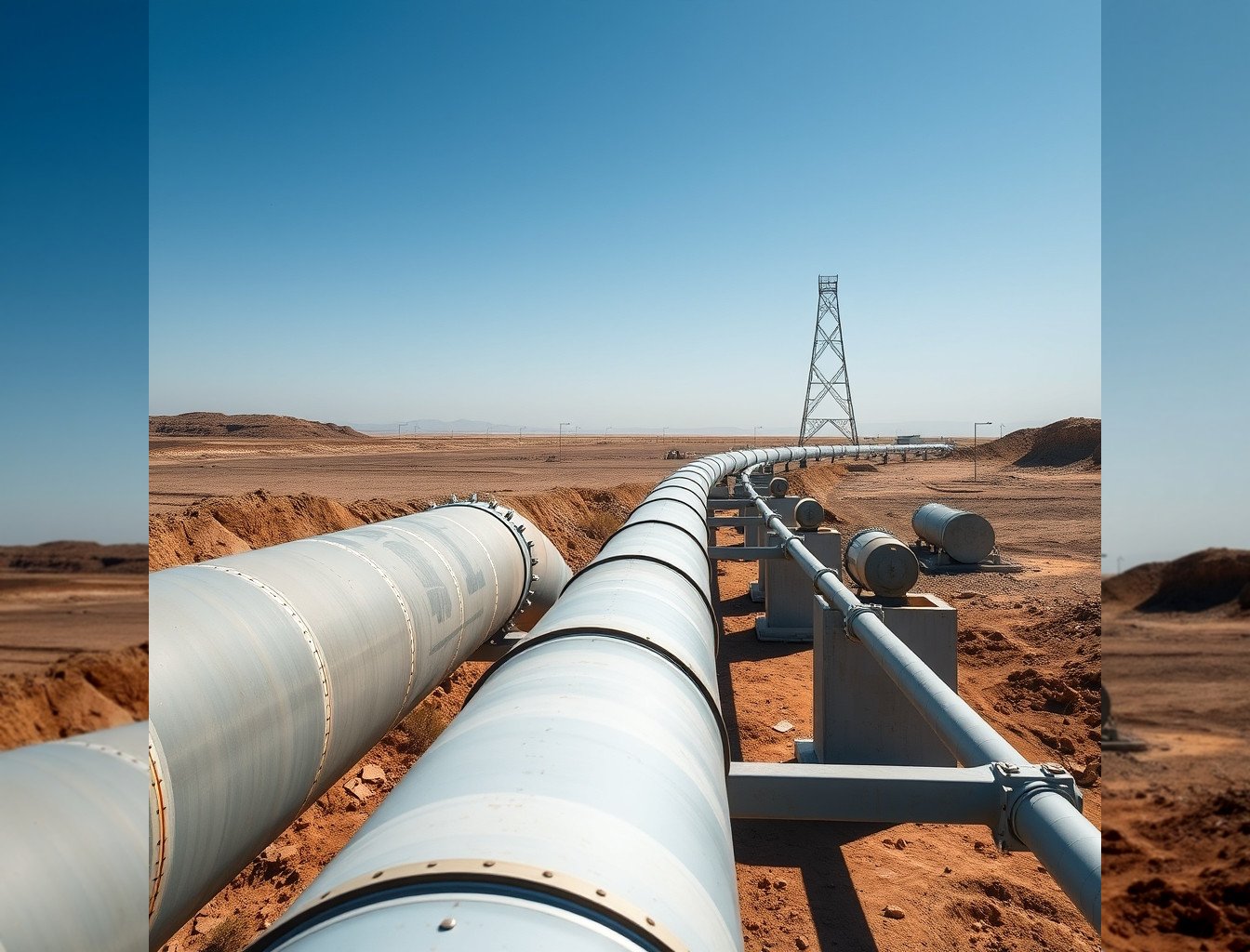
Algeria’s state energy giant SONATRACH has finalised plans for a $25 billion trans-Saharan gas pipeline that will link Nigeria’s offshore fields to Europe via Niger and Algeria. The project, known as the Trans-Saharan Gas Pipeline (TSGP), is set to become the largest single infrastructure investment in North Africa this decade.
According to Ynetnews, the 4,128 km pipeline will transport up to 30 billion cubic metres of natural gas annually once operational. SONATRACH holds a 51 % stake, with Nigeria’s NNPC and Niger’s NIGELEC sharing the remaining equity. Construction is scheduled to begin in late 2026, with first gas expected in 2030.
Why the pipeline matters for Algerian business
The TSGP will double Algeria’s current export capacity of 50 bcm per year, reinforcing its position as Europe’s third-largest gas supplier after Russia and Norway. For Algerian entrepreneurs, this means a surge in demand for local engineering, logistics and security services. SONATRACH has already issued tenders for pipeline coating, compressor stations and fibre-optic monitoring systems, creating opportunities for domestic SMEs.
The project also includes a 1,500 km fibre-optic backbone that will run alongside the pipeline. Algeria’s Ministry of Digital Transition has announced a separate $200 million tender for last-mile connectivity in southern wilayas, opening a new market for telecoms start-ups.
Financial and geopolitical stakes
The $25 billion budget is split into three tranches: $10 billion for upstream development in Nigeria, $12 billion for the pipeline itself, and $3 billion for Algerian onshore infrastructure. Financing is secured through a mix of SONATRACH’s cash reserves, African Development Bank loans and private equity from Gulf investors.
Geopolitically, the pipeline reduces Europe’s dependence on Russian gas. In 2025, Algeria supplied 12 % of the EU’s gas imports; the TSGP could push that share to 20 % by 2032. This shift has prompted the European Commission to fast-track a €1.2 billion grant for Algerian renewable energy projects, aiming to free up more gas for export.
Risks and local impact
Security remains the biggest challenge. The pipeline crosses three conflict-prone regions: Nigeria’s Niger Delta, Niger’s Agadez and Algeria’s Tamanrasset. SONATRACH has contracted Algeria’s Groupe Mazouz to provide armed escorts and drone surveillance, creating a new niche for private security firms.
In southern Algeria, the project will require 15,000 temporary workers and 3,000 permanent jobs. Local authorities in Adrar and Tindouf have already begun vocational training programmes in welding, pipeline maintenance and cybersecurity. The wilaya of Adrar has allocated 500 hectares for a logistics hub, expected to attract light manufacturing and warehousing businesses.
What’s next for entrepreneurs
SONATRACH has published a supplier portal listing 47 categories of goods and services needed for the project. Registration is open to Algerian-registered companies with a minimum three-year track record. The first round of contracts, worth $1.8 billion, will be awarded in early 2027.
Key takeaway for entrepreneurs
The Trans-Saharan Gas Pipeline will inject $25 billion into Algeria’s economy over the next decade, creating demand for engineering, logistics and security services. Entrepreneurs should register on SONATRACH’s supplier portal and explore partnerships with European firms seeking local expertise in pipeline construction and renewable energy integration.
Sources
- Ynetnews
- AL24 News
- SolarQuarter
- HESPRESS English – Morocco News
- Daily Sabah
- News Deeply
💡 Starting a business in Algeria? GlobalStart guides you step by step: procedures, real costs, company forms (SARL, EURL, SPA) and CNRC registration.