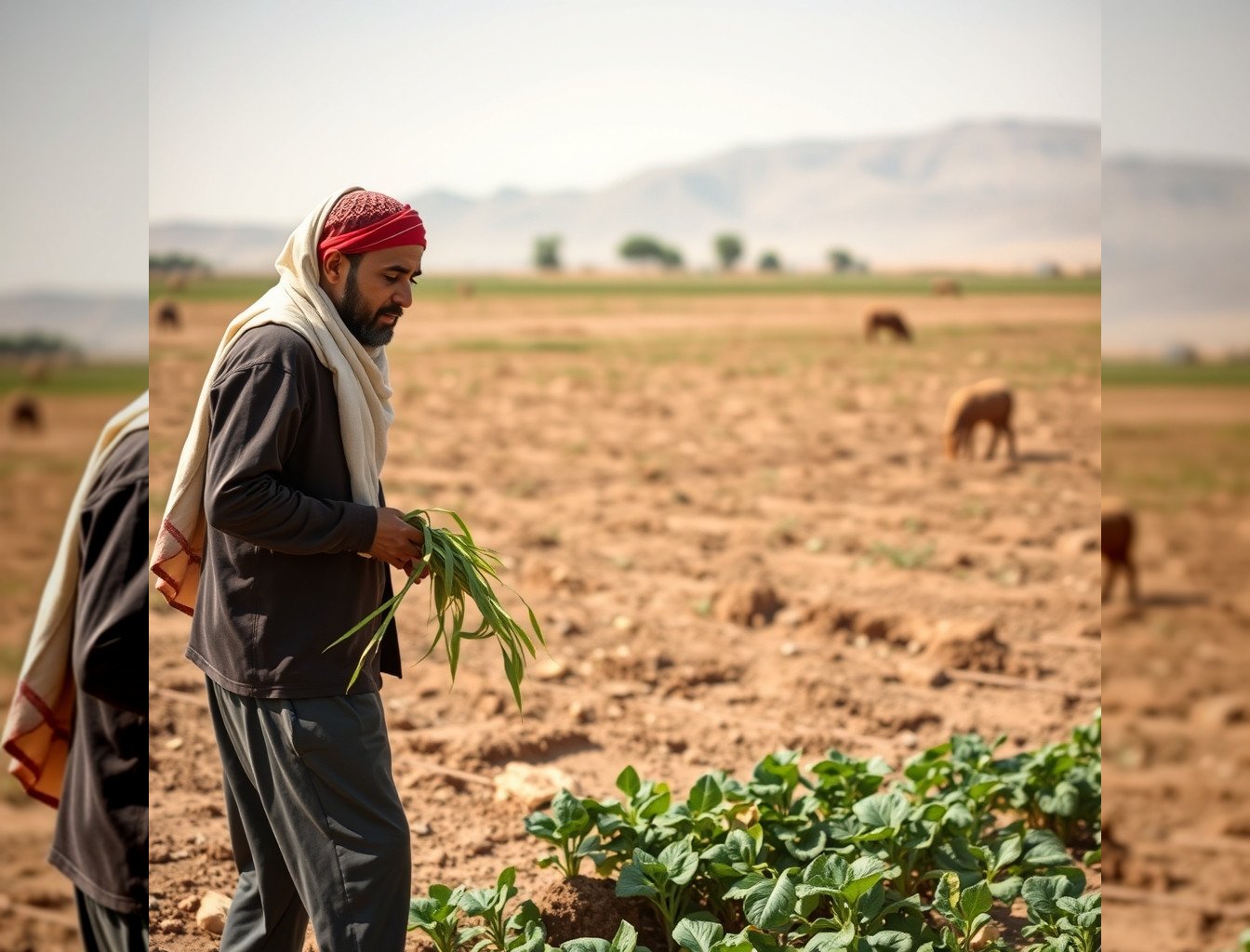
Climate, food security and the economy: the drought effect
April 2024 heatwave readings across Spain, Portugal, Morocco and Algeria show that the extreme temperatures were five times more likely due to climate change, according to World Weather Attribution data released this week. In Algeria, the National Meteorological Office recorded temperatures 4.5–6°C above seasonal norms on 19–25 April, with wilting in cereal-growing governorates. The Ministry of Agriculture reported a 15% decline in April rainfall compared with the ten-year average, cutting soil moisture in the High Plains to 38% of field capacity.
The impact on cereals is immediate: the Ministry of Trade confirmed Algeria will miss its 2024 target to cut wheat and barley imports by 8%, now projecting a 6% reduction instead. Private grain importers report tender prices for milling wheat up 11% month-on-month to 385 USD/tonne cif Algiers, while barley feed prices reached 320 USD/tonne cif Oran. Rain-fed wheat output is forecast at 1.2 million tonnes versus 1.8 million tonnes in 2023, widening the import requirement to 5.4 million tonnes of wheat for the 2024/25 marketing year. Barley imports are now expected at 1.7 million tonnes, up 280,000 tonnes on the previous forecast.
Agriculture’s share of GDP in 2023 was 12.3%, down from 13.1% in 2021, yet the sector still employs 18% of the workforce. The government’s emergency water package for farmers—announced 2 May—allocates 12 billion DZD (85 million USD) for irrigation repairs and groundwater drilling, targeting 35,000 hectares of supplemental irrigation. The National Agency for Hydraulic Resources also issued tenders for 150 mobile desalination units for wilaya-level use, with bids due 14 May.
Education and language shift: the operational detail
The Ministry of Higher Education confirmed the transition from French to English as the primary language of instruction in 34 state universities starting the 2024/25 academic year. The pilot phase covers first-year students in sciences, technology, economics and medicine, totaling 68,000 seats. Course materials will be in English, while French remains an elective. The ministry’s budget for English-language teacher recruitment rose from 450 million DZD in 2023 to 720 million DZD in 2024, financing 380 new contract instructors from the UK, Ireland, Canada and the US.
The shift affects existing private tutoring providers: the largest chain, Centre de Préparation aux Concours, reported a 22% drop in its French-language science sections and a 30% increase in English-language course registrations since the announcement. The company has hired 12 native English instructors and plans to open three new branches in Oran, Constantine and Annaba by September.
Research and space: new assets and old questions
The Algerian Space Agency (ASAL) confirmed the successful launch of AlSat-3A on 23 April aboard a Chinese Ceres-1 rocket from a sea platform, placing the satellite into a 550 km sun-synchronous orbit. AlSat-3A carries a high-resolution optical imager (2.5 m panchromatic, 10 m multispectral) and will support agricultural monitoring and urban planning. ASAL also finalized a 30 million USD contract with China Great Wall Industry Corporation for the development of AlSat-6, an X-band radar satellite due for launch in 2026.
In earth sciences, teams from the University of Ouargla and the Centre de Recherche en Astronomie, Astrophysique et Géophysique reported the classification of a 1-billion-year-old Martian meteorite (NWA 15412) found in the Tanezrouft region in 2022. The sample, weighing 426 g, shows unique igneous textures and may contain preserved microstructures for astrobiology studies. The researchers have submitted a sample to NASA’s Mars Sample Return curation facility for comparative analysis.
Tourism and heritage: investment versus risk
The Algiers Metro extension works at the Tafourah-Mohammed V station uncovered 87 ceramic vessels, 37 coins and architectural remains dated between the 11th and 16th centuries, according to the National Institute of Archaeology and Heritage. The finds include Almohad-period storage jars and a Fatimid-era copper ingot, now exhibited at the Bardo Museum pending a site museum decision. The Ministry of Culture allocated 180 million DZD for conservation and public display.
On climate risk, the World Bank’s updated coastal vulnerability index ranks Algiers, Oran and Annaba among the top 15% of cities globally for sea-level rise by 2100. The study projects an average 0.8 m rise in the Mediterranean by 2100, putting 72 km of Algeria’s railway lines and 48 km of national roads within the 1-in-100-year flood zone. The Ministry of Public Works has commissioned a 120 million USD resilience plan covering 11 coastal wilayas, including elevated road sections and seawalls at 23 sites.
Restoration work began on the Roman city of Timgad, a UNESCO World Heritage site, with a 95 million DZD tranche from the National Tourism Development Fund. The project covers the Antonine baths, the library and 1.2 km of the decumanus maximus. The site recorded 84,000 visitors in 2023, up 18% on 2019, and the fund projects a 25% increase by 2026 with improved access and security.
Geopolitics and security: Sahel focus and Algerian posture
The African Centre for Strategic Studies reported 1,147 violent incidents involving non-state armed groups in the Sahel during Q1 2024, a 22% increase compared with Q4 2023. Algeria’s foreign ministry confirmed the deployment of 120 additional troops to the Malian border under the G5 Sahel framework, bringing Algeria’s Sahel troop presence to 1,070. The deployment follows the 3 May announcement of a joint counter-terrorism exercise with Mauritania in the Tindouf region, involving 450 soldiers and 20 combat helicopters.
On migration, the Algerian Army reported the dismantling of two smuggling networks in the Tlemcen and Béchar regions during the week, resulting in the arrest of 27 individuals—nine Algerians, 18 Moroccans—and the seizure of five 4×4 vehicles and 180,000 USD in cash. The Ministry of Interior confirmed that 6,842 irregular migrants were intercepted attempting to cross into Morocco between January and April 2024, up 8% on the same period in 2023.
Culture and music: niche revival and tourism leverage
The Tassili n’Ajjer region hosted the third edition of the Taghit Women’s Music Festival, reviving the Ahidous tradition performed exclusively by Tuareg women. The festival drew 1,200 visitors, 65% domestic, generating 9.2 million DZD in direct revenue for local guesthouses and restaurants. The Ministry of Culture allocated 6 million DZD for the event, citing its role in rural tourism diversification.
Meanwhile, the Inteam nasheed group headlined the 27 April Algeria Destination Festival in Algiers, drawing 8,500 attendees and media coverage valued at 12 million DZD in advertising equivalent. The Ministry of Youth and Sports used the event to promote youth employment initiatives, announcing 1,500 seasonal jobs in event logistics and security.
Constitutional reforms: the institutional mechanics
The National Independent Electoral Authority published the final text of the constitutional amendments on 1 May, with 68 articles amended and one new article added (Article 177 bis) recognizing Tamazight as an official language alongside Arabic and “for the enrichment of the national culture and the unity of the people.” The reforms also reinstate a two-term presidential limit and extend local council mandates from four to six years.
Parliamentary debates cited the 2021 Hirak protests and the need for language normalization in education and administration. The High Council of Tamazight reported a 14% increase in Tamazight language course registrations at 23 public universities in the first quarter of 2024.
Irrigation and technical cooperation
Algeria hosted a three-day regional forum on irrigation efficiency in Nouakchott, attended by representatives from Mauritania, Mali, Niger and the African Union. The Algerian delegation presented results from the 2023–2024 drip irrigation pilot in the M’zab Valley, where water use efficiency improved by 22% and tomato yields by 15% in smallholder plots. The forum agreed to establish a regional training center in Béchar, with Algerian expertise and financing of 2 million USD over two years.
Balance of the week: figures and decisions
– Climate: April temperature anomaly +5.2°C across cereal belt; soil moisture 38% of capacity.
– Cereals: Wheat import target missed by 8%; import requirement now 5.4 million tonnes.
– Education: 68,000 first-year students shift to English; budget for English instructors up 60%.
– Space: AlSat-3A launched; AlSat-6 contract signed for 2026.
– Tourism: Timgad restoration begins with 95 million DZD; coastal resilience plan at 120 million USD.
– Security: 27 arrested in smuggling networks; Sahel troop presence at 1,070.
– Culture: Taghit festival revenue 9.2 million DZD; Algeria Destination festival media value 12 million DZD.
– Reforms: 69 constitutional articles amended; Tamazight courses up 14%.
Key takeaway for entrepreneurs
The April drought has lifted wheat and barley import prices by 11% and 9% respectively. Agribusiness founders should prioritize drought-resistant seed varieties and irrigation efficiency upgrades given the 12 billion DZD state fund for farmers. English-language tutoring and EdTech startups targeting the 68,000 first-year university cohort face immediate demand following the policy shift.
Sources
- Archaeology Magazine
- Undark Magazine
- University World News
- The Arab Weekly
- World Border Security Congress
- Middle East Monitor
💡 Starting a business in Algeria? GlobalStart guides you step by step: procedures, real costs, company forms (SARL, EURL, SPA) and CNRC registration.