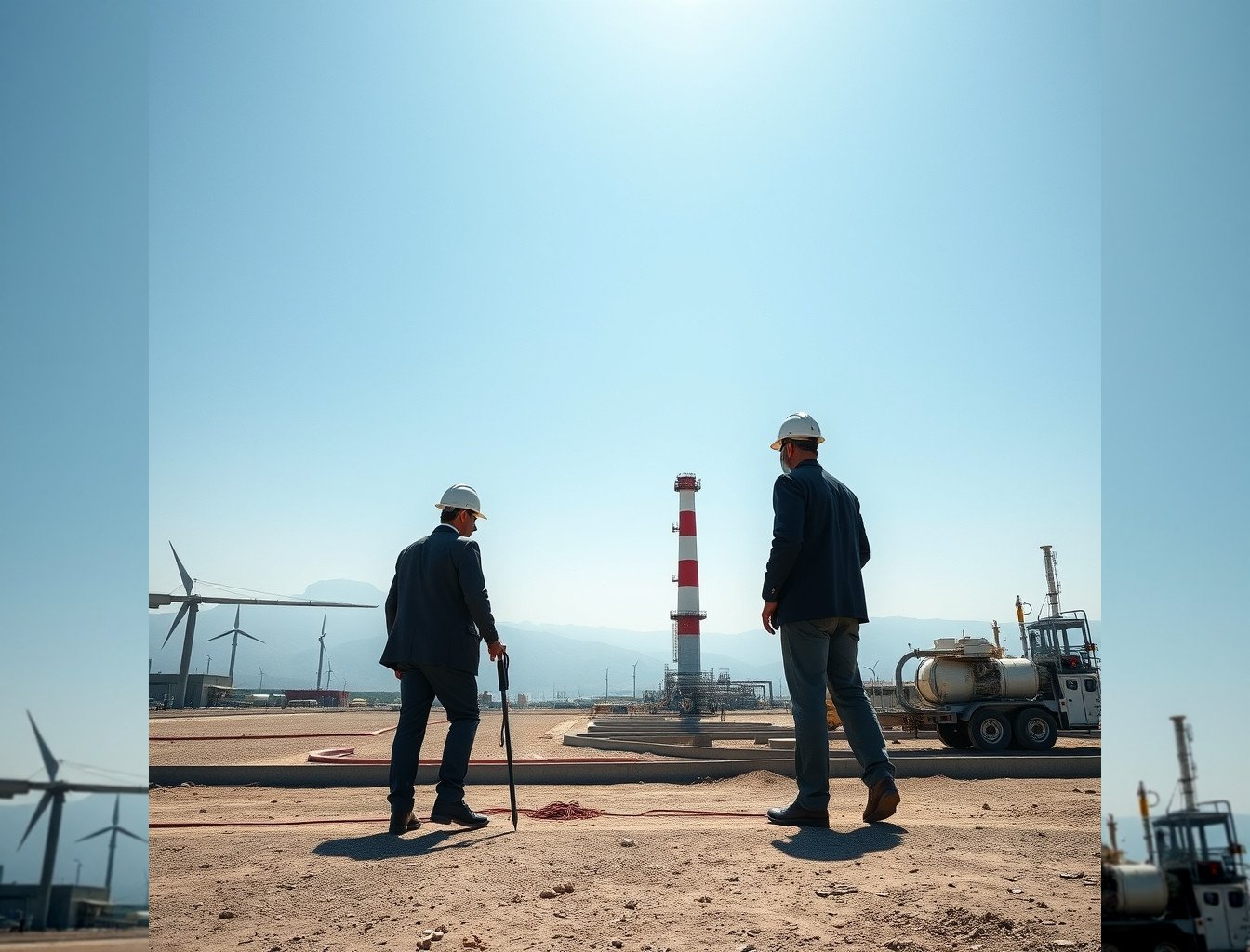
Energy Sector: Shale and Frontier Blocks Take Center Stage
Algeria is accelerating efforts to unlock unconventional and frontier hydrocarbon resources. This week, reports indicated that U.S. majors—including ExxonMobil and Chevron—are in advanced negotiations to access Algeria’s shale gas reserves, following a 2024 memorandum of understanding with Sonatrach. The country’s shale potential is estimated at 707 trillion cubic feet (Tcf) of gas, per the U.S. Energy Information Administration (EIA), positioning Algeria as the third-largest shale gas reserve holder globally.
Parallelly, Algeria launched Algeria Bid 2026, offering seven oil and gas exploration blocks in frontier regions, including the Atlas Mountains and the Ahnet Basin. The tender, open until December 31, 2025, targets international operators with expertise in tight gas and deepwater drilling. Sonatrach projects these blocks could add 200,000 barrels per day (bpd) of oil and 1.5 billion cubic feet (Bcf) of gas annually by 2028.
For entrepreneurs: Foreign investors must structure joint ventures with Sonatrach, which holds a minimum 51% stake in production-sharing contracts. Legal frameworks for unconventional projects remain under review, with draft amendments expected in Q4 2025 to address water usage and seismic risks.
Regional Relations: Migration, Trade, and Diplomatic Frictions
Algeria’s relationship with Morocco remains strained, with Rabat rebuking Algiers over its “unacceptable conduct” at a UNESCO cultural event marking 30 years of Algerian-Kazakh ties. The dispute underscores ongoing tensions over Western Sahara and border closures.
Human rights groups renewed calls for accountability over the 1975 expulsion of Moroccan nationals from Algeria, citing unresolved cases of property seizures and forced displacement. The Algerian government has not commented publicly on the allegations.
In Sub-Saharan Africa, Algeria’s trade footprint remains limited despite diplomatic overtures. The African Development Bank (AfDB) approved an $878 million loan for Algeria’s trans-Saharan railway, linking Algiers to Lagos via Niger and Nigeria—a project aimed at boosting intra-African trade. However, financing gaps persist for customs infrastructure, with Algeria’s contribution to the $11.2 billion project still undetermined.
For entrepreneurs in logistics: The railway’s first phase (Tamanrasset–In Salah) is slated for completion by 2028, with tenders expected for rolling stock and signaling systems in 2026. No foreign consortiums have been shortlisted yet.
Literature and Soft Power: Censorship vs. Cultural Export
The case of imprisoned journalist and writer Mohamed Mouloudj, dubbed the “Voltaire of the Arabs” by French media, gained traction in France this week. Mouloudj, serving a three-year sentence for “undermining national unity,” has become a symbol of Algeria’s restrictive press laws. His works, which critique political Islam, are widely circulated in France but banned in Algeria.
Meanwhile, Algeria’s cultural diplomacy faced scrutiny at UNESCO, where Moroccan delegates accused Algerian officials of politicizing heritage events. Algeria’s Independence Day (July 5, 2027) is set to be a focal point for state-sponsored celebrations, with budgets allocated for museums and commemorative projects.
For entrepreneurs in publishing: Algeria’s literary market remains closed to foreign publishers without local partnerships. State-owned Entreprise Nationale du Livre (ENL) holds a monopoly on book imports, with import licenses requiring approval from the Ministry of Culture.
Infrastructure and Investment: Railway, Ports, and Fiscal Updates
Algeria secured an $878 million AfDB loan for the trans-Saharan railway, part of a $1.2 billion package including Algerian government funds. The 3,000 km route will reduce cargo transit times from 14 to 7 days between Algeria and West Africa. However, land acquisition delays in Niger and Nigeria can add up to 18 months to the timeline.
In port development, French logistics giant CMA CGM is pursuing a $300 million investment in Algeria’s container terminal at Djen Djen Port (Jijel), pending government concessions. The project aims to double capacity to 1.2 million TEUs annually by 2027.
The 2025 Finance Law, enacted this week, introduces new tax incentives for foreign investors:
– 50% corporate tax exemption for 10 years in priority sectors (renewable energy, agribusiness, pharmaceuticals).
– Streamlined customs clearance for machinery imports, reducing delays from 30 to 10 days.
– Restrictions on equity transfers in strategic sectors (hydrocarbons, defense, transport) remain unchanged, requiring Ministry of Commerce approval for any foreign shareholding above 30%.
For entrepreneurs in logistics: Algeria’s Port Autonome d’Alger (PAA) will auction 15-year concessions for bulk cargo terminals in Q1 2026, with bids capped at $200 million per contract.
Housing and Social Pressures: Public Funding vs. Market Needs
The Caisse Nationale du Logement (CNL), led by CEO Mohamed Ourak, announced a 2025 budget of $3.2 billion for social housing, targeting 120,000 units—down from 150,000 in 2024 due to budgetary constraints. The shortfall has led to a 20% increase in informal settlements in Algiers, per UN-Habitat estimates.
Oil revenues, projected at $45 billion in 2025 (down from $55 billion in 2024), are insufficient to cover housing deficits without austerity measures. The government has ruled out direct subsidies for private developers, instead offering tax rebates for projects in underserved regions.
For entrepreneurs in real estate: The Loi de Finances 2025 grants a 25% VAT exemption for first-time buyers in rural areas, but mortgage interest rates remain fixed at 7.5% for state-backed loans, dampening demand.
Tourism: Niche Growth and Branding Challenges
Algeria’s tourism sector saw two contrasting developments:
1. A feature in National Geographic highlighted Algeria’s Sahara road network, with Algeria positioning itself as a “high-end adventure destination.” The article cited Algeria’s 90,000 km of paved roads, including 1,200 km of desert tracks.
2. However, tourism arrivals in 2025 are projected at 3.2 million (down from 4.1 million in 2019), with European visitors (60%) declining due to visa restrictions and safety concerns.
The government’s Plan Tourisme 2030 aims to attract 5 million visitors annually by 2030, focusing on heritage sites (Timgad, Tipasa) and coastal resorts (Béjaïa, Annaba). Investments include $400 million for hotel renovations and $150 million for visa liberalization pilots in 2026.
For entrepreneurs in hospitality: Foreign hotel chains must partner with local firms to access land leases in coastal zones. The Agence Nationale de Développement du Tourisme (ANDT) offers 10-year tax holidays for projects in the Grand Sud (southern regions).
Public Works: China’s Role and Industrialization Push
Algeria and China deepened industrial cooperation this week, with Chinese firms securing contracts for:
– A $1.8 billion phosphate processing plant in Tébessa (capacity: 2 million tons/year).
– A $900 million solar panel factory in Ouargla, part of Algeria’s Renewable Energy Program 2035 (target: 30% of energy mix by 2030).
The Algeria–China Industrial Era initiative, launched in 2024, now includes 45 joint ventures, with Algerian labor laws requiring 60% local employment in Chinese-managed projects.
For entrepreneurs in manufacturing: Joint ventures with Chinese partners require Algerian majority ownership (51%) in non-strategic sectors. The Agence Algérienne de Promotion de l’Investissement (AAPI) provides matching grants of up to $500,000 for tech transfers.
Key Takeaway for Entrepreneurs
Sources
- The Washington Post
- EY
- Arabian Gulf Business Insight | AGBI
- The Christian Science Monitor
- Transnational Institute
- Caspian Post
💡 Starting a business in Algeria? GlobalStart guides you step by step: procedures, real costs, company forms (SARL, EURL, SPA) and CNRC registration.