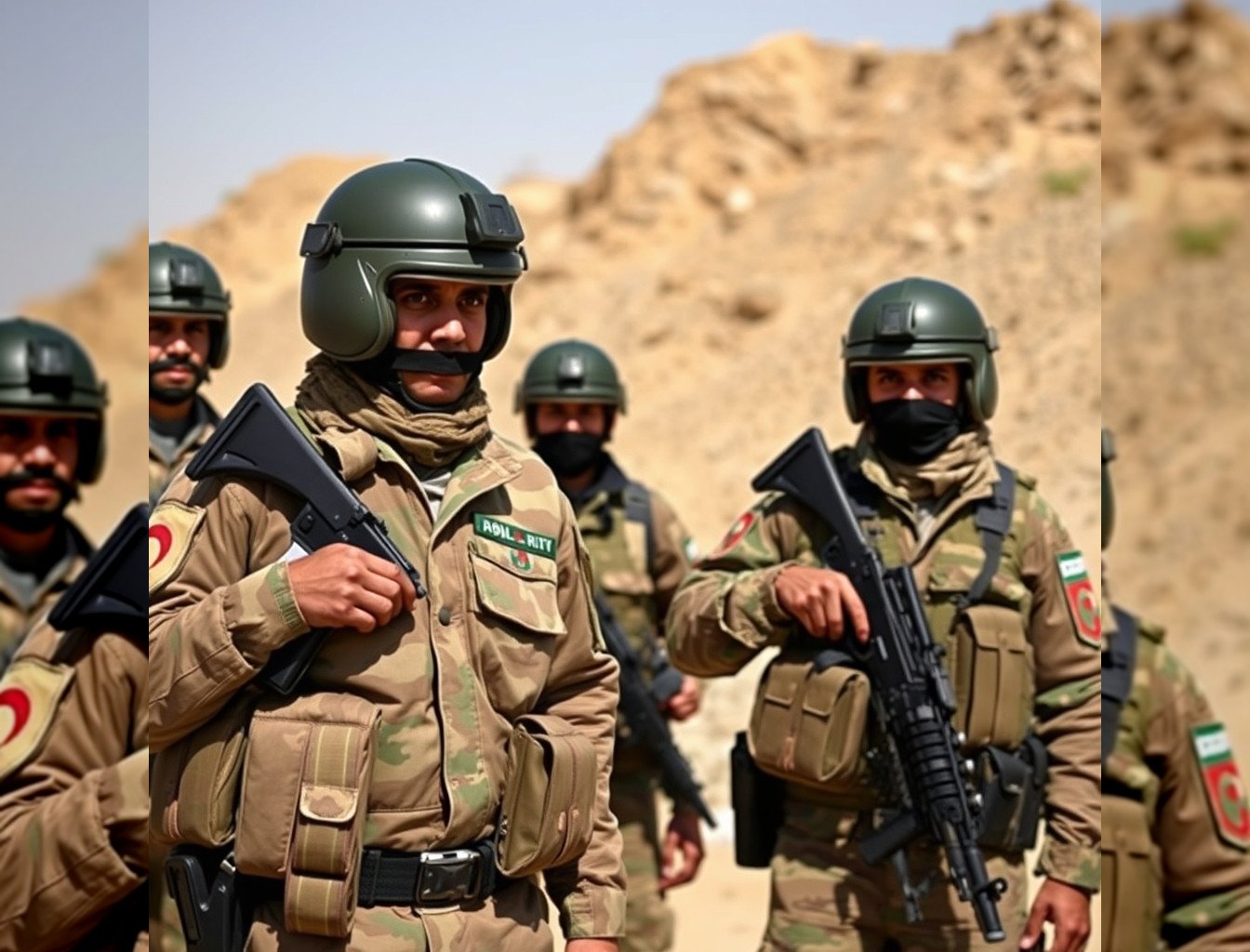
Regional security tensions escalate
Algeria’s military conducted a high-profile exercise near the Morocco border under the supervision of the chief of staff, reflecting sustained border tensions. The drill follows a reported “new level of escalation” in diplomatic and military exchanges between Algiers and Rabat over Western Sahara and other disputes.
Separately, an Al-Qaeda-linked ambush in Niger, 40 km from the Algerian border, killed 11 soldiers. Algerian authorities did not comment on direct involvement but reiterated commitments to regional counter-terrorism cooperation under the G5 Sahel and bilateral arrangements with Niger.
The security climate raises operational costs for logistics firms operating trans-Saharan routes and increases insurance premiums for cross-border trade corridors.
Energy diplomacy gains pace
Germany’s Friedrich Merz publicly urged the acceleration of a hydrogen pipeline project linking Algeria to Europe via Italy, describing it as a “strategic infrastructure corridor.” The proposed route would traverse 2,200 km, including Algeria’s Tinhert and Hassi R’Mel gas fields and onward through Italy, with an estimated capacity of 10 billion cubic meters per year by 2030.
Algeria’s state-owned energy company Sonatrach separately confirmed ongoing feasibility studies with Italian and German partners, with a final investment decision expected in 2027. Sonatrach also reported first-quarter 2026 exports of 14.2 billion cubic meters of pipeline gas to Italy, up 8% year-on-year.
Spanish Prime Minister Pedro Sánchez concluded a two-day visit to Algiers aimed at strengthening energy ties, including discussions on LNG supply diversification. No new long-term supply contracts were announced, but both sides agreed to establish a joint energy working group.
For European utilities and industrial buyers, Algerian gas remains a key diversification option amid reduced Russian flows, particularly for Italian and Spanish buyers where Algerian pipeline gas accounts for 38% and 25% of total imports, respectively, as of Q1 2026.
Intra-African trade focus intensifies
The Intra-African Trade Fair (IATF2025) opened in Algiers with calls from African Union officials for faster implementation of the African Continental Free Trade Area (AfCFTA). Algerian Trade Minister Tayeb Zitouni announced the launch of a national AfCFTA implementation unit with a $12 million budget to support SMEs in export compliance.
However, Brussels-Algiers dialogue on trade and investment was reported as “hindered” by unresolved disputes over tariffs on Algerian tomato paste and wine imports into the EU, affecting an estimated $420 million in annual exports.
Algeria also hosted agricultural training sessions in Nouakchott, sharing drip irrigation expertise and promoting a joint Sahel water management initiative with Mauritania and Mali. The Algerian National Agency for the Development of Irrigation (ANDI) reported a 15% rise in Algerian-designed irrigation systems deployed in West Africa since 2023, including 43 pilot farms in Mauritania covering 2,800 hectares.
For Algerian agri-tech startups, the regional demand represents a $180 million addressable market for irrigation equipment and training services by 2028, according to ANDI projections.
Urban and digital infrastructure investments accelerate
President Abdelmadjid Tebboune oversaw the launch of 12 strategic projects in Algiers, including a $350 million wastewater treatment plant in Baraki and a $190 million ring road segment connecting eastern and western districts. The projects are funded through the 2026 national investment budget of $14.3 billion, with 62% allocated to transport and water infrastructure.
In Oran, the government broke ground on an AI data center with a capacity of 120 megawatts, intended to support domestic cloud services and reduce reliance on foreign providers. The facility is part of the “Smart Cities Algeria” initiative, which aims to deploy 850 public Wi-Fi hotspots and 15 smart traffic systems across eight cities by 2027.
Early-stage Algerian tech firms report improved access to government cloud services via the new hub, reducing latency for local applications from 200ms to under 50ms.
Cultural and heritage initiatives in focus
The government nominated five Berber mausoleums from antiquity for UNESCO World Heritage status, including the 2,300-year-old Royal Mausoleum of Numidia in El Khroub. Algeria has pledged $4.7 million for restoration and documentation ahead of the 2027 UNESCO review cycle.
In music, a Tuareg women’s musical tradition, Tishumarin, was revived through a cultural festival in Djanet, supported by the Ministry of Culture. The event featured 47 female performers from Algeria, Mali, and Niger, with performances broadcast on national television and social media platforms.
For Algerian cultural entrepreneurs, the UNESCO bid increases tourism potential in eastern Algeria, where pre-Islamic heritage sites are currently visited by fewer than 120,000 international tourists annually. The government aims to double this figure by 2030 with targeted hospitality and transport upgrades.
Scientific and technological milestones
A 1-billion-year-old Martian meteorite, classified as NWA 12564, was identified in Algeria’s Tanezrouft region during a joint Algerian-French geological survey. The specimen, weighing 237 grams, is being studied at the Centre de Recherche en Astronomie, Astrophysique et Géophysique (CRAAG) in Algiers.
China’s Ceres-1 rocket launched Algeria’s AlSat-3A Earth observation satellite into polar orbit, marking the country’s 12th operational satellite. The payload includes a high-resolution camera with a 1.2-meter resolution, intended for agricultural monitoring and urban planning. The satellite is part of Algeria’s National Space Programme 2026-2030, with total funding of $620 million.
Local geospatial startups report improved access to real-time agricultural and land-use data, enabling precision farming services for commercial farms.
Sports integrity and diplomacy
INTERPOL and the International Olympic Committee (IOC) signed a memorandum of understanding with Algeria’s Ministry of Youth and Sports to combat match-fixing and doping in national leagues. The agreement follows two doping cases in Algerian football in Q1 2026, affecting player eligibility in continental competitions.
President Abdel Fattah El-Sisi of Egypt met Algerian Foreign Minister Ahmed Attaf in Cairo to discuss bilateral cooperation, including energy and security, with no new agreements announced.
Algeria’s football association confirmed a cultural and training exchange program with the English Football Association, aimed at youth development, following Algeria’s historic World Cup participation in 2026.
Balance of the week
1. Security: Military exercises and regional terrorism raise operational risks for cross-border businesses.
2. Energy: Hydrogen pipeline and gas exports to Europe remain top diplomatic and economic priorities.
3. Trade: AfCFTA implementation gains momentum, but EU tariff disputes persist.
4. Infrastructure: $1.2 billion in new urban and digital projects announced, supporting tech and construction sectors.
5. Heritage: UNESCO bid and cultural festivals position Algeria as a regional cultural hub.
6. Science: Algeria’s space and geological research gains global visibility with new satellite launch and Martian meteorite discovery.
7. Sports: Anti-doping and integrity measures strengthened amid international collaborations.
Key takeaway for entrepreneurs: Cross-border logistics face higher risks due to regional tensions. Energy and water infrastructure projects offer opportunities in irrigation tech and digital services. AfCFTA implementation and EU market access remain key trade variables. Space and heritage sectors provide niche openings for startups in geospatial data, restoration, and cultural tourism.
Sources
- The Borgen Project
- Türkiye Today
- Modern Diplomacy
- Space
- Futura, le média qui explore le monde
- Africa Defense Forum
💡 Starting a business in Algeria? GlobalStart guides you step by step: procedures, real costs, company forms (SARL, EURL, SPA) and CNRC registration.