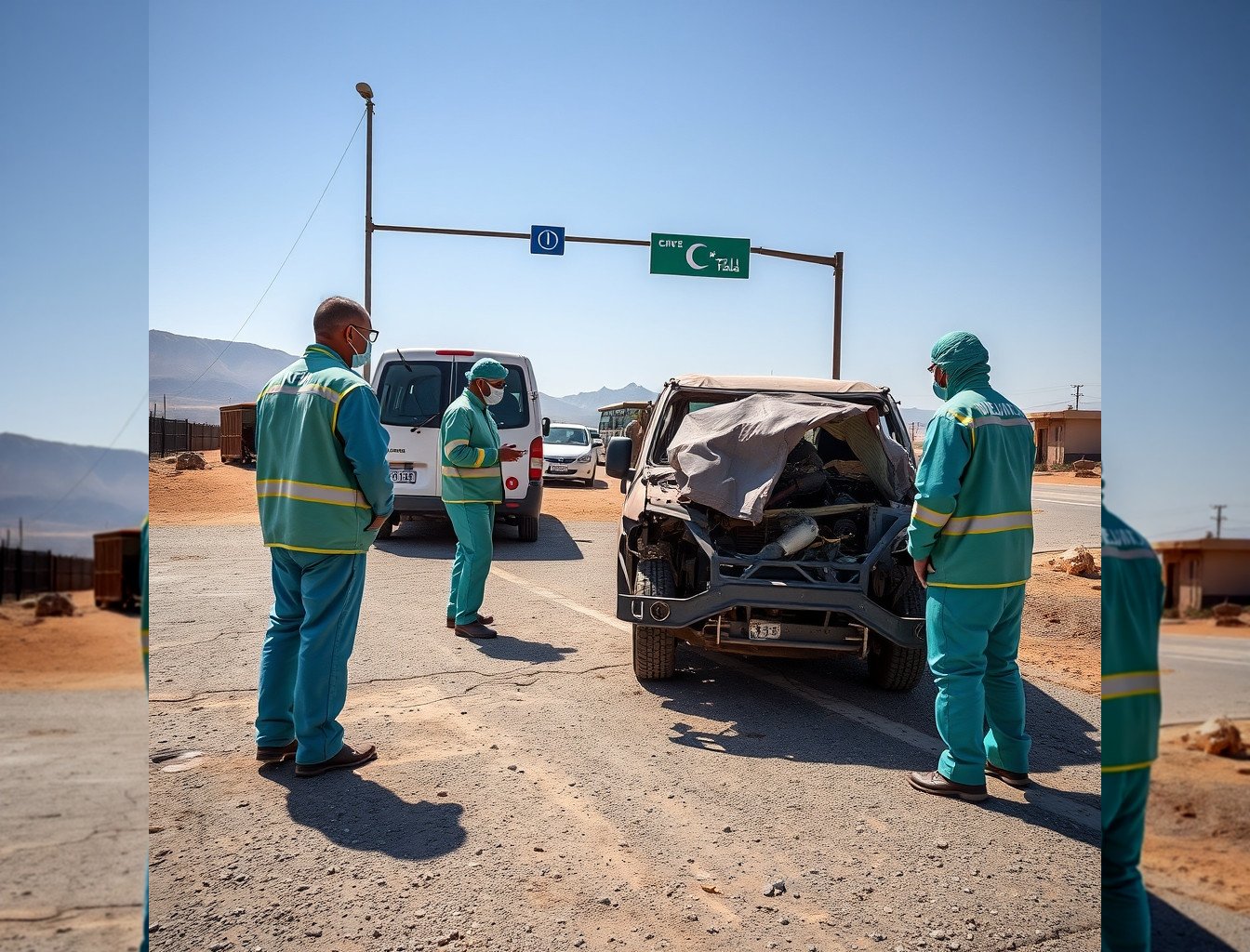
This week, Algerian Health Minister Mohamed Seddik Aït Messaoudene made two rapid visits to southern hospitals following fatal traffic accidents, underscoring the government’s response to road safety failures and emergency care gaps. On Monday, Aït Messaoudene traveled to Timimoun after a collision between a passenger bus and a truck killed four and injured 43, according to Algérie Presse Service (APS). Just days later, he inspected Ain Sefra’s public hospital, where victims of a bus rollover were being treated. Both incidents occurred on Algeria’s remote desert highways, where poor road conditions and driver fatigue frequently contribute to deadly crashes.
The Timimoun accident, which took place on a Saturday evening, involved a bus carrying 47 passengers. The collision with a truck near the town’s outskirts left 12 in critical condition, APS reported. Local authorities attributed the crash to excessive speed and mechanical failure, though an official investigation is ongoing. At Timimoun’s hospital, Aït Messaoudene assured families that all victims would receive “optimal care,” a phrase repeated in ministry statements following both accidents. The minister’s presence at the scene—acting on direct instructions from President Abdelmadjid Tebboune—reflects a broader push to improve emergency response in Algeria’s southern provinces, where medical infrastructure lags behind the north.
Algeria’s road death toll remains stubbornly high. The National Road Safety Agency (NRA) recorded 3,200 fatalities in 2025, a slight decrease from previous years but still among the highest rates in North Africa. The government has introduced stricter penalties for speeding and drunk driving, yet enforcement remains inconsistent, particularly in rural areas. The Ain Sefra accident, which occurred on a stretch of National Route 6 near the Moroccan border, highlighted another persistent issue: overcrowded buses. Survivors told APS the vehicle was carrying more passengers than its 50-seat capacity, a common practice on long-distance routes where demand outstrips supply.
Southern hospitals strain under demand
Timimoun and Ain Sefra, both in the Sahara region, rely on small public hospitals ill-equipped for mass casualty events. The Timimoun hospital, with just 120 beds, scrambled to treat the influx of injured, transferring five critical patients to larger facilities in Adrar and Bechar. Aït Messaoudene’s visit included an assessment of the hospital’s emergency ward, which has been expanded in recent years but still lacks specialized trauma units. “We are accelerating the deployment of mobile medical teams to remote areas,” the minister told reporters, though he did not specify a timeline.
The Ministry of Health has prioritized upgrading southern hospitals since 2023, when Tebboune launched a $1.2 billion infrastructure plan. New facilities in Tamanrasset and Ouargla have since opened, but progress has been slow in smaller towns. Ain Sefra’s hospital, for example, still operates with a single CT scanner, forcing patients to travel 200 kilometers to Naama for advanced imaging. Local doctors say the delays stem from bureaucratic hurdles and a shortage of medical staff willing to work in the region’s harsh climate.
Tebboune’s direct oversight
President Tebboune’s involvement in the aftermath of these accidents marks a shift in how Algeria handles road safety crises. Unlike previous administrations, which often delegated such incidents to regional governors, Tebboune has personally intervened in high-profile cases, including a 2025 bus fire in Sétif that killed 21 people. His instructions to Aït Messaoudene to “ensure no victim is left without care” were echoed in a cabinet meeting last month, where he criticized the “negligence” of local officials in enforcing transport regulations.
The president’s focus on road safety aligns with a broader national strategy to reduce traffic deaths by 50% by 2030. The plan includes expanding the highway network, introducing speed cameras on rural roads, and mandating seatbelt use in all vehicles. However, critics argue the measures do not address the root causes of Algeria’s road crisis: poor driver training, lax vehicle inspections, and a culture of impunity for traffic violations. A 2025 report by the Algerian League for Human Rights found that 60% of fatal crashes involved unlicensed drivers or vehicles with expired registration.
International cooperation on emergency response
Algeria’s struggles with road safety have drawn attention from international partners. In June, the World Health Organization (WHO) pledged $5 million to support emergency medical services in the country’s south. The funds will be used to train paramedics and equip ambulances with defibrillators, a critical need in regions where response times can exceed two hours. “Algeria’s vast geography presents unique challenges,” said WHO representative Dr. Ahmed Zouiten during a visit to Algiers. “But with targeted investments, we can save lives.”
The government has also sought technical assistance from France and Turkey, both of which have reduced road fatalities through stricter enforcement and public awareness campaigns. A delegation from France’s National Interministerial Road Safety Observatory visited Algiers in May to share best practices on data collection and accident prevention. Meanwhile, Turkish firm Otokar has supplied 200 ambulances to Algeria since 2024, with plans to deliver another 100 by the end of 2026.
Public frustration grows
Despite these efforts, public anger over road safety has intensified. Social media videos of the Timimoun crash, showing the bus’s mangled frame and bloodied passengers, sparked outrage online. Many Algerians blamed the government for failing to address chronic issues like overloaded vehicles and poorly maintained roads. “We’ve been hearing the same promises for years,” said Karim Belkacem, a resident of Adrar whose cousin was injured in the Ain Sefra accident. “But nothing changes.”
The Ministry of Transport has responded by launching a hotline for reporting unsafe buses, though critics say the system is understaffed and slow to act. In July, the ministry suspended 12 bus companies for violating safety regulations, but activists argue the penalties are too lenient. “A few fines won’t stop drivers from speeding or overloading their vehicles,” said Fatima Zohra, a road safety advocate in Oran. “We need real accountability.”
Next steps for Algeria’s health system
Aït Messaoudene’s visits to Timimoun and Ain Sefra may signal a more hands-on approach to emergency care, but the challenges remain daunting. The Ministry of Health plans to open three new trauma centers in the south by 2027, though construction delays are likely. In the meantime, the government is relying on mobile clinics to fill the gap. Last month, the army deployed 10 medical teams to remote areas, a temporary measure that underscores the lack of permanent facilities.
For now, the focus remains on preventing further tragedies. The NRA has announced unannounced roadside checks in the coming weeks, targeting buses and trucks on high-risk routes. But with summer travel peaking and temperatures exceeding 45°C, the risk of accidents remains high. As Aït Messaoudene told reporters in Timimoun, “Every life lost on our roads is one too many.” The question is whether Algeria’s health and transport systems can turn that sentiment into action.
Sources
💡 Starting a business in Algeria? GlobalStart guides you step by step: procedures, real costs, company forms (SARL, EURL, SPA) and CNRC registration.