Week’s main trends
Algeria’s military expenditure remains the highest budget item for 2026, while diplomatic friction with France deepens. The education ministry has switched university languages from French to English, altering human-capital conditions for foreign investors. Wildfire response mobilized 123 units across three days, and the 2025 Finance Law introduced new corporate levies. Regional energy projects involving Nigeria and Morocco continue to exclude Algeria.
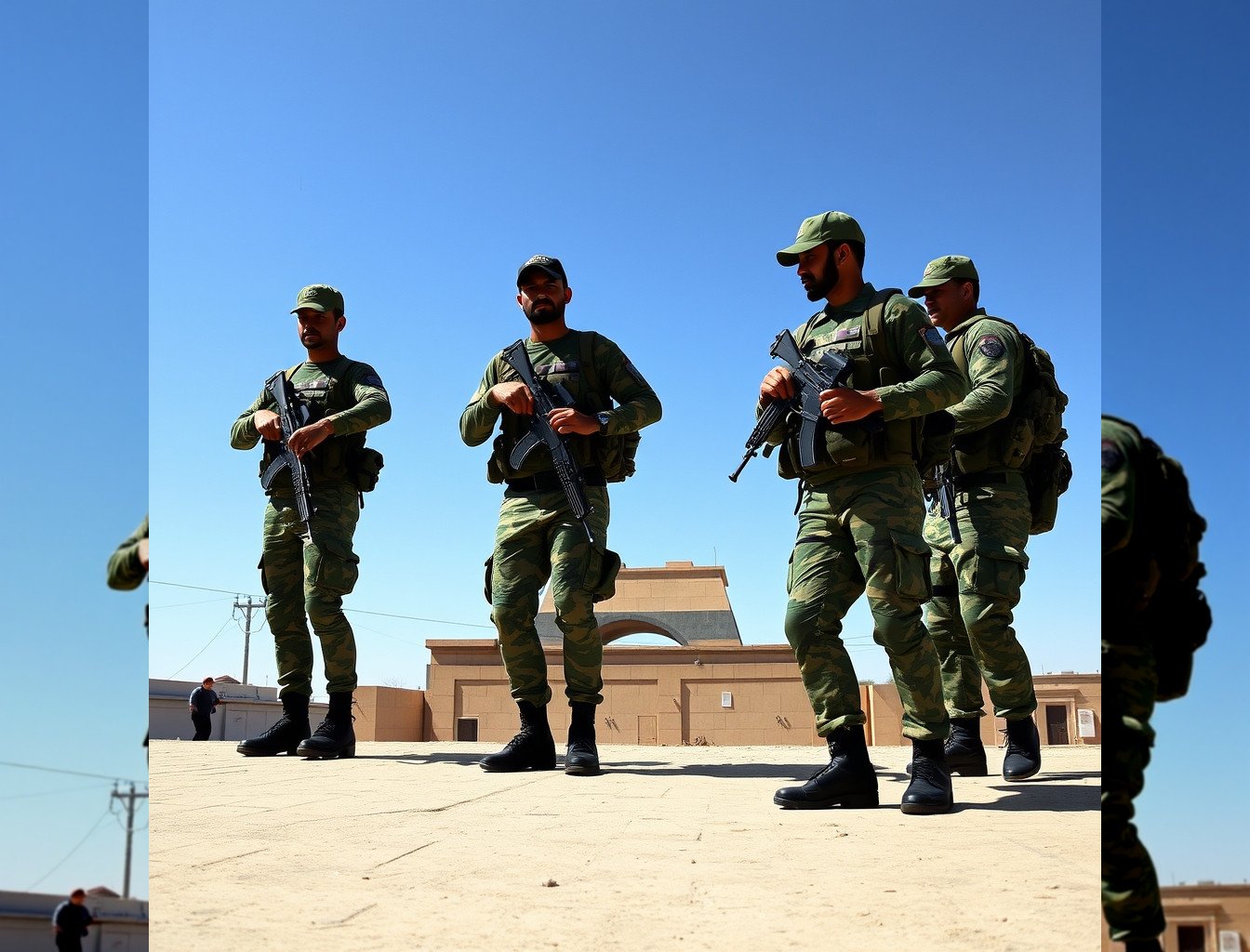
Defense: Arms overtake all other budget lines
Algeria will spend the equivalent of USD 11.2 billion on defense in 2026, 27 % of total state outlays, according to the draft budget published 2 July. This places Algeria second globally in arms spending as a share of GDP after Ukraine. The 2026 figure is flat year-on-year after a 5 % increase in 2025, when defense absorbed USD 10.7 billion. Equipment procurement accounts for 68 % of the defense budget; salaries and pensions take 22 %, logistics 7 %, and R&D 3 %.
The Maghreb arms race context: Morocco’s 2025 defense budget is USD 12.1 billion (10 % GDP), up from USD 11.6 billion in 2024. Algeria’s procurement in 2025 includes four Su-57E fighters, 36 Rafale F4s, and 24 Yasen-M submarines from Russia under contracts signed in 2022-2024. France has not delivered any new-generation combat aircraft to Algeria since 2019; Paris cites export-license delays.
Business relevance: Public tenders for base construction, cyber-defense systems and drone platforms are tendered via the Ministry of Defence Procurement Directorate. Registration requires a local industrial partner holding at least 51 % Algerian capital. Tender documents are published in Arabic and French; English translations are not standard.
Algeria-France relations: Historical narratives dominate diplomacy
On 3 July, historian Benjamin Stora stated in Le Monde that the current Algeria-France relationship is the worst since independence in 1962. Talks on visa facilitation, energy cooperation and joint investment funds remain stalled since Algeria suspended high-level meetings in April 2024 over French statements on Western Sahara.
France has maintained a cap of 8,000 long-stay visas per month for Algerians since September 2021. Algeria reciprocated by cutting French cultural centre budgets in Algiers, Oran and Constantine by 35 % in the 2025 Finance Law.
Sectoral impact:
– Tourism: French visitor arrivals fell 18 % year-to-date through May 2025 compared with 2024.
– Education: Algeria’s shift to English at universities reduces demand for French-language textbooks and teacher exchanges. French publisher Hachette closed its Algiers office in March 2025.
– Energy: TotalEnergies’ renewable joint venture (30 % Algerian state participation) has delayed final investment decision on a USD 1.8 billion solar park in Adrar until visa and licensing issues are resolved.
Education: Language switch alters human-capital pipeline
Minister of Higher Education Kamel Baddari announced on 28 June that French will be phased out as the primary university language by the 2026-2027 academic year. English will replace it in scientific, technical and medical faculties. French-language sections will be maintained only in law and literature until 2028.
Key figures:
– 1.3 million university students enrolled in 2024-2025.
– STEM programs currently taught 75 % in French, 25 % in English pilot programs.
– The National Academy of Sciences estimates 40 % of STEM faculty will require retraining by 2027.
Entrepreneur implications:
– Startups targeting tech, pharma or engineering talent will need English-language recruitment platforms and training modules.
– Foreign universities seeking partnerships must align curricula with Algerian accreditation bodies (CNEPRU) within 12 months.
– Translation and localization firms report a 300 % spike in demand for English-Arabic scientific glossaries.
Housing & Social: Oil buffers still prevent price shocks
The 2025 Finance Law raised the corporate income tax rate for construction firms to 26 % from 23 %, effective 1 January 2025. The levy funds a new housing subsidy program targeting 15,000 low-income families in 2025.
CNL (National Housing Agency) CEO Mohamed Ourak told El Moudjahid on 29 June that 42,000 social housing units were delivered in H1 2025, down 12 % against target due to land-title delays. The agency’s 2025 investment budget is DZD 280 billion (USD 2.1 billion).
Social indicators:
– Algeria’s oil and gas revenues reached USD 34.2 billion in H1 2025, up 14 % year-on-year.
– Inflation in construction materials (steel, cement, glass) averaged 8 % in Q2 2025, tracked by the National Statistics Office.
Wildfires & Civil Protection: Emergency deployments tested
Between 28 June and 1 July, 123 wildfires burned 4,800 hectares across Tizi Ouzou, Bejaia and Jijel. Civil Protection units mobilized 118 teams (4,300 personnel), 26 helicopters and 5 drones. The prime minister visited burn victims at Zeralda hospital on 2 July, announcing DZD 500 million (USD 3.7 million) in emergency relief.
Burned areas:
– Tizi Ouzou: 2,100 ha, 45 % pine forest.
– Jijel: 1,400 ha, 30 % agricultural land.
– Bejaia: 1,300 ha, 25 % cork oak.
Regional Energy: Maghreb pipeline excludes Algeria
The Nigeria-Morocco Gas Pipeline Project, valued at USD 26 billion, reached a feasibility agreement on 30 June. The 5,660 km pipeline will supply Nigeria, Benin, Togo, Ghana, Côte d’Ivoire, Liberia, Sierra Leone and Morocco, with an export terminal in Dakhla. Algeria is not a signatory; the Trans-Saharan Gas Pipeline (TSGP) remains stalled since 2022 due to security concerns in the Sahel.
Algeria’s state energy company Sonatrach reported 2024 oil production at 1.6 million barrels per day, down 5 % from 2023, and gas output at 130 billion cubic meters, flat year-on-year.
Heritage & Culture: Contrasting preservation policies
On 1 July, Morocco announced the restoration of the Ghriba Synagogue on Djerba Island, a project budgeted at MAD 30 million (USD 3.1 million). In Algeria, authorities demolished the 19th-century Sidi Abderrahmane Mosque in Algiers on 30 June to make way for a highway, citing structural instability. The Ottoman-era Villa Boulkine in Algiers remains on the heritage protection list after a 2023 decree but has no allocated restoration budget for 2025.
Diaspora & Investment: 2025 Finance Law targets foreign capital
The 2025 Finance Law introduces three measures affecting foreign entrepreneurs:
1. A 5 % withholding tax on dividends paid to non-resident shareholders, up from 0 %.
2. Mandatory electronic invoicing for all corporations, including foreign subsidiaries, starting 1 October 2025.
3. A 12-month grace period for repatriating capital invested before 31 December 2024; after that date, repatriation requires central bank approval.
The government also extended the “Carte de Résident Algérien” program, allowing foreign founders to obtain renewable 10-year residency if they invest USD 500,000 or create 50 jobs. As of 1 July, 187 applications have been processed since the program launched in January 2024.
Domestic Politics: Stability measures amid protests
Prime Minister Nadir Larbaoui met wildfire victims in Zeralda hospital on 2 July, pledging DZD 500 million in relief. On 29 June, Foreign Minister Ahmed Attaf reviewed bilateral cooperation with Libya’s acting foreign minister in Algiers, signing three agreements on border security, energy and migration.
Civil society groups staged protests in Algiers on 26 June demanding the resignation of the CNL board over housing delays. No official response was issued.
Key takeaway for entrepreneurs
Algeria’s 2026 defense budget consumes 27 % of state spending, reducing fiscal space for non-military contracts. The mandatory shift to English in STEM universities requires foreign firms to adjust recruitment and training within 12 months. Foreign entrepreneurs must register a local partner for defense tenders and comply with new dividend withholding (5 %) and electronic invoicing rules.
Sources
- APS English
- Stimson Center
- The Libya Observer
- Le Monde.fr
- VOA – Voice of America English News
- Ynetnews
💡 Starting a business in Algeria? GlobalStart guides you step by step: procedures, real costs, company forms (SARL, EURL, SPA) and CNRC registration.