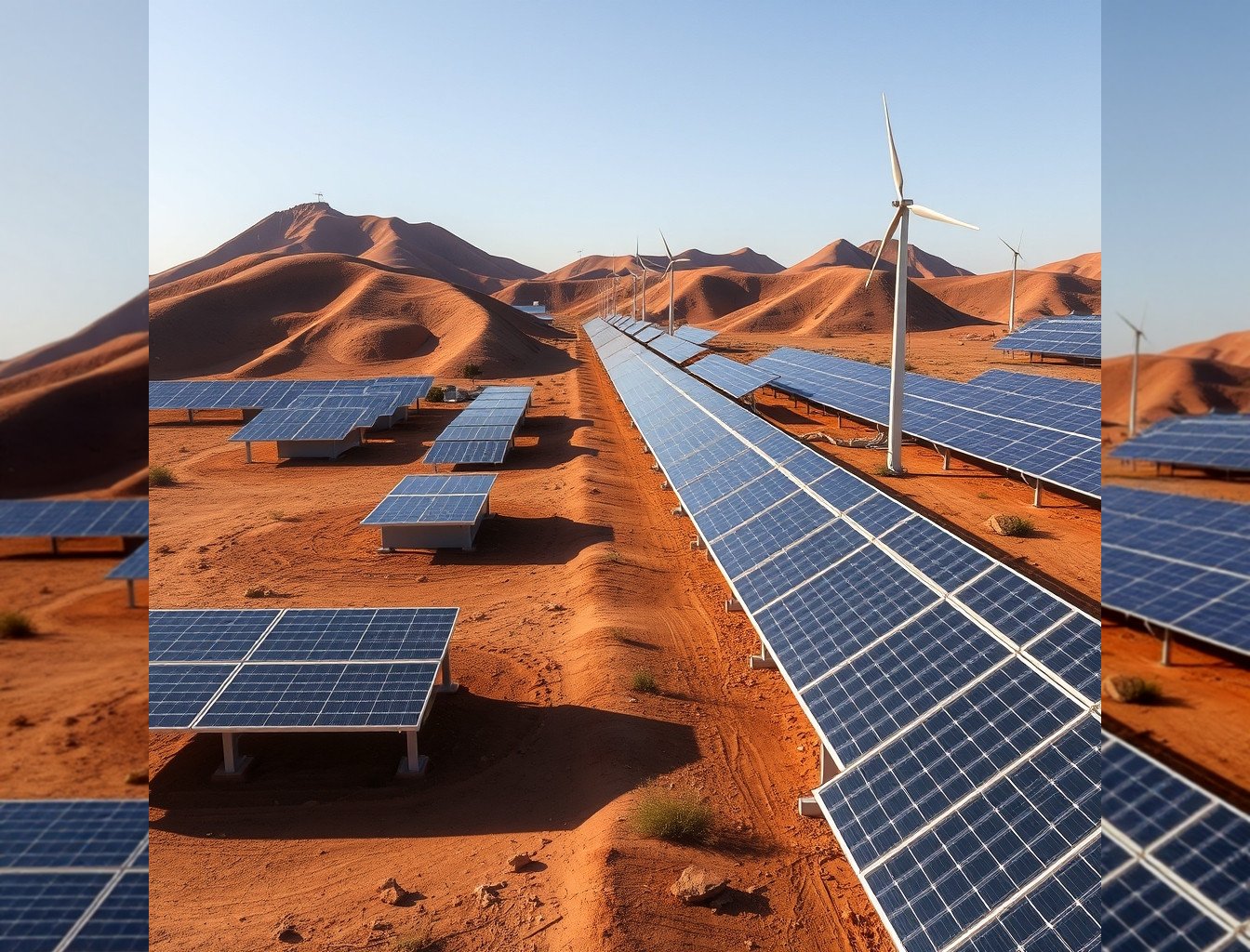
Algeria’s government has unveiled a $60 billion five-year investment plan to build one of Africa’s largest renewable energy sectors, a move that opens the door to foreign capital, technology transfers and new business models for local and diaspora entrepreneurs.
The pledge, announced recently by President Abdelmadjid Tebboune, comes as the state rebrands its energy policy beyond hydrocarbons and toward solar, wind and green hydrogen. SONATRACH and Sonelgaz, the country’s energy giants, will co-lead projects alongside a newly created Ministry of Energy Transition and Renewables, headed by Energy Minister Mohamed Arkab.
Industrial planners estimate the programme will install 15 GW of solar power and up to 10 GW of wind capacity by 2030, with the first 5 GW targeted for completion by 2027. Wind projects in Adrar, Tlemcen and Béchar are already under feasibility study, according to the Ministry of Energy Transition and Renewables.
Foreign investors are expected to bankroll the majority of projects through build-own-operate-transfer contracts, providing predictable returns over 20–25 years. The Algerian government will guarantee power-purchase agreements at fixed tariffs indexed to inflation, removing currency risk for dollar-based financiers.
Local private firms see three near-term opportunities. First, equipment assembly: Sonatrach’s photovoltaic-panel factory in Hassi R’mel plans to raise output from 100 MW to 500 MW a year by 2026, creating procurement contracts for aluminium frames, glass and inverters. Second, O&M services: Sonelgaz has opened tenders for operation and maintenance of pilot solar parks in Ouargla and Djelfa, with foreign operators invited to partner with Algerian subcontractors. Third, storage and grid integration: Algeria’s first 100 MW battery storage pilot is scheduled for launch in 2026 at the M’sila solar complex, requiring specialist engineering and software providers.
The diaspora is already positioning itself. A coalition of Algerian engineers in Germany and France has formed Algerian GreenTech, a start-up that designs micro-grid software for rural cooperatives. “We see demand from cooperatives in Ghardaïa and Laghouat that want to go off-grid,” says co-founder Yacine Boussouf. “Algeria’s net metering law, updated in June 2025, now allows them to sell surplus back to the grid at 70 percent of the retail tariff, creating a viable market.”
Financial structuring is emerging as a bottleneck. Banks are reluctant to lend long-term without central-bank guarantees, while foreign lenders demand hard-currency escrow accounts. The government is negotiating a $3 billion credit line with the African Development Bank to backstop local banks, expected to be signed in early 2026.
Entrepreneurs should note that the tender pipeline is accelerating. Sonelgaz recently listed 22 solar projects totalling 3.7 GW for pre-qualification, with pre-bids scheduled in Tlemcen next month. Each project will require environmental impact assessments, grid-connection studies and land-rights negotiations with local communes—opening consulting, legal and surveying niches.
Green hydrogen is the second pillar of the plan. Algeria aims to export 20 million tonnes of green hydrogen a year by 2040, leveraging its solar irradiance and vast desert sites. Sonatrach and Germany’s RWE signed a memorandum of understanding in November 2025 to build a 3 GW electrolyser complex near Arzew. The partners will supply Europe via a planned trans-Mediterranean pipeline, creating procurement for pipes, turbines and electrolysers.
Diaspora entrepreneurs can tap a new talent-recruitment window. The Ministry of Energy Transition and Renewables launched “Algeria GreenTech Fellowship,” granting 100 scholarships annually for Algerian students in renewables at overseas universities, with a return-to-work clause.
Political risk remains the wildcard. Recent labour strikes in the oil sector raised concern over wage indexation and currency controls. “Investors will demand stable legal frameworks before committing capital,” warns Algerian economist Salima Benmouiza at the University of Algiers.
Key takeaway for entrepreneurs
Algeria’s $60 billion renewable plan offers clear procurement timelines: 3.7 GW of solar tenders opening in early 2026 and 10 GW of wind projects under feasibility study. Local assembly of PV components and O&M services are the fastest entry points for small and diaspora firms, while green hydrogen projects near Arzew will require large-scale partnerships. Currency hedging and escrow structures remain unresolved, so secure bankable guarantees before committing capital.
Sources
- African Energy
- Nature
- Industrial Info Resources
- AL24 News
- ASHARQ AL-AWSAT English
- Crude Oil Prices Today | OilPrice.com
💡 Starting a business in Algeria? GlobalStart guides you step by step: procedures, real costs, company forms (SARL, EURL, SPA) and CNRC registration.