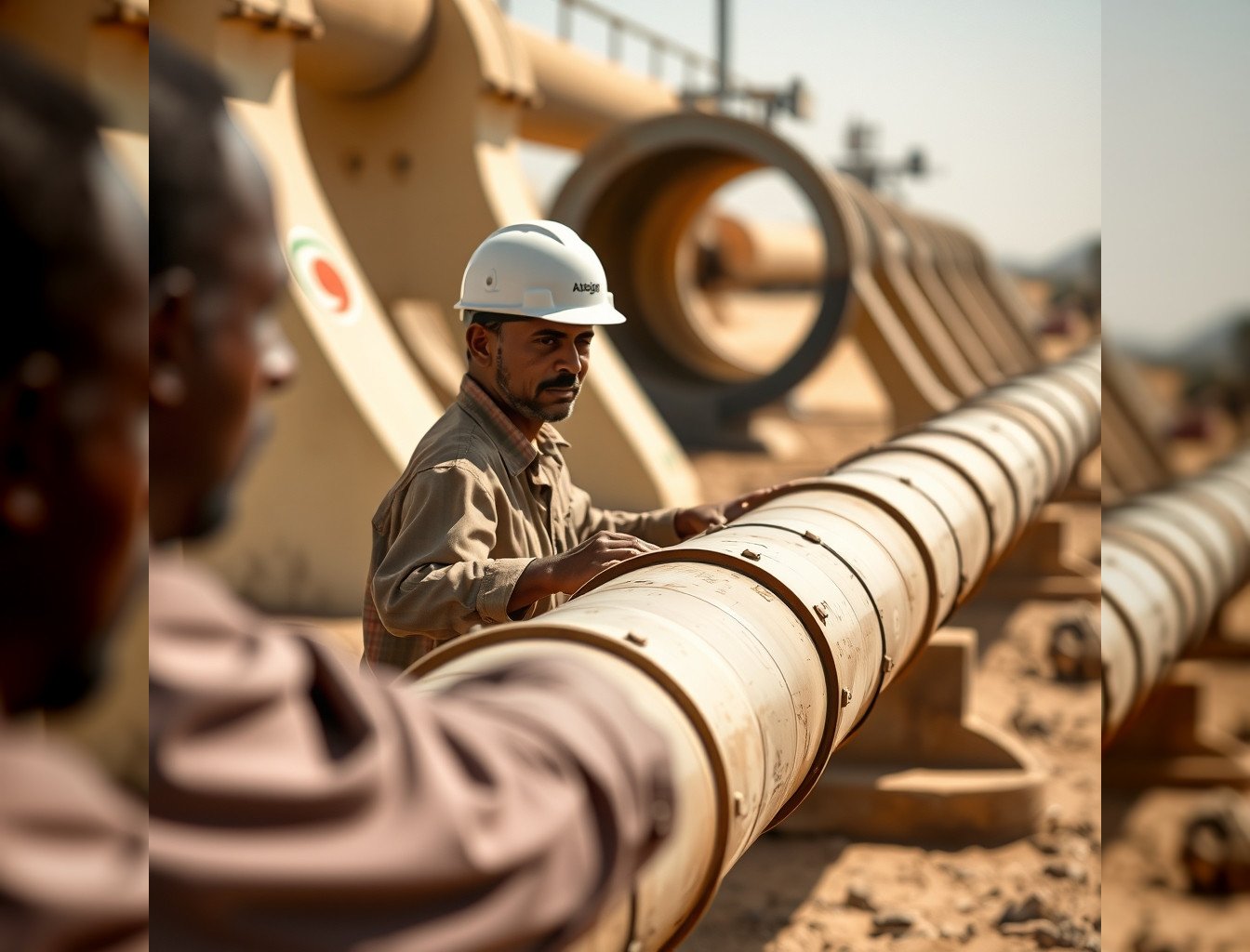
Algeria is leveraging its gas infrastructure to reposition itself as the Sahel’s energy backbone, a move that directly challenges Morocco’s regional ambitions and U.S. influence. The strategy, dubbed the “Sahel Thaw” by The Times of Israel in February 2026, centers on extending Algeria’s existing pipelines—particularly the Trans-Saharan Gas Pipeline (TSGP)—into Niger and Mali, bypassing Morocco’s proposed Nigeria-Morocco Gas Pipeline (NMGP).
According to The Times of Israel, Algeria’s state-owned SONATRACH has accelerated feasibility studies for a 2,000-kilometer extension of the TSGP, which would link Nigeria’s gas fields to Algeria’s Mediterranean export terminals via Niger. The project, valued at $13 billion, would secure Algeria’s role as a transit hub while offering landlocked Sahelian nations a direct route to European markets. SONATRACH’s CEO, Toufik Hakkar, stated in a recent interview with El Watan that the pipeline could deliver 30 billion cubic meters (bcm) of gas annually by 2030, with Niger and Mali receiving 5 bcm each as transit fees—equivalent to $1.5 billion in annual revenue for both countries.
The geopolitical calculus is clear. Algeria’s pipeline gambit undermines Morocco’s NMGP, a $25 billion project that Rabat has marketed as a cornerstone of its Africa strategy. By offering Sahelian states immediate financial incentives—Niger’s government, for instance, expects $300 million annually in transit royalties—Algiers is positioning itself as a more reliable partner than Morocco, which has faced criticism for conditional aid tied to Western Sahara recognition. Middle East Eye reported in October 2021 that Algeria’s diplomatic push includes waiving transit fees for the first five years of operation, a move that could sway cash-strapped Sahelian governments.
For entrepreneurs, the implications are twofold. First, Algeria’s energy diplomacy opens new markets. The pipeline extension will require local contractors for construction, maintenance, and security—sectors where Algerian firms like COSIDER and private security companies such as Groupe Hasnaoui are already expanding. SONATRACH’s tender documents, reviewed by Reuters, indicate that 40% of the pipeline’s construction contracts will be reserved for Algerian and Sahelian companies, creating opportunities for joint ventures in engineering, logistics, and renewable energy integration.
Second, the project could redefine Algeria’s trade corridors. The TSGP extension aligns with Algiers’ broader push to revive trans-Saharan trade routes, a priority outlined in President Abdelmadjid Tebboune’s 2023 economic recovery plan. The Algerian Customs Directorate recently announced a 20% reduction in transit fees for goods moving between Algeria and Niger, a move that could lower costs for Algerian exporters targeting West African markets. Entrepreneurs in agribusiness, pharmaceuticals, and construction materials—sectors where Algeria has a competitive edge—stand to benefit from reduced tariffs and streamlined border procedures.
The U.S. response has been cautious. The Washington Institute noted in December 2022 that Washington views Algeria’s pipeline diplomacy as a counterbalance to Russian and Chinese influence in the Sahel, but remains wary of SONATRACH’s dominance. The U.S. State Department has signaled support for private-sector participation in the project, particularly in renewable energy integration. For Algerian startups in solar and hydrogen, this could mean access to U.S. funding and technology partnerships, as outlined in the U.S.-Algeria Energy Dialogue launched in 2023.
Security remains a wildcard. Algeria’s military, led by Army General Saïd Chanegriha, has framed the pipeline as a tool for stabilizing the Sahel, citing its counterterrorism cooperation with Mali and Niger. Al-Sharq Al-Awsat reported in April 2026 that Algeria has deployed additional troops along its southern borders to secure the pipeline’s route, a move that could reassure investors but also escalate tensions with Morocco. Entrepreneurs operating in the region should factor in elevated insurance costs and potential delays due to security protocols.
Key takeaway for entrepreneurs
Algeria’s pipeline diplomacy is creating a new energy corridor linking North and West Africa, with SONATRACH reserving 40% of construction contracts for local firms. The project could reduce trade costs for Algerian exporters targeting Sahelian markets, while U.S. support for private-sector involvement may unlock funding for renewable energy startups. Security risks, however, could inflate operational costs in the short term.
Sources
- middle-east-online.com
- The Times of Israel
- Middle East Eye
- Warsaw Institute
- The Tahrir Institute for Middle East Policy –
- Le Monde.fr
💡 Starting a business in Algeria? GlobalStart guides you step by step: procedures, real costs, company forms (SARL, EURL, SPA) and CNRC registration.