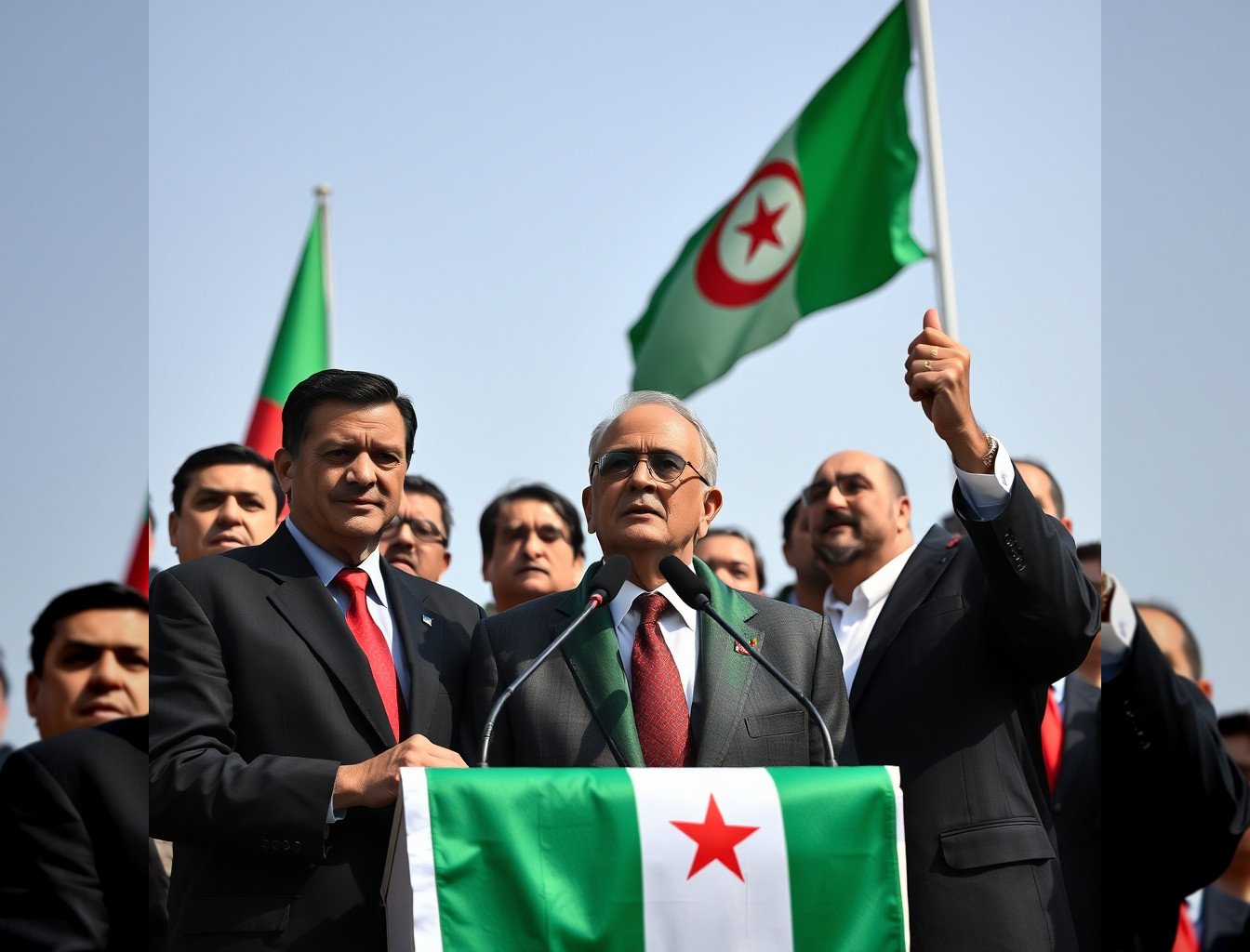
This week, Algeria’s economic and political agenda was marked by leadership transitions, climate-driven food security concerns, and renewed investment in urban infrastructure. Political parties reshuffled leadership amid protests, while urban planning initiatives prioritized smart-city development and digital infrastructure. Drought conditions worsened, threatening cereal import targets, and geopolitical shifts positioned Algeria as a potential Sahel security actor. These developments intersect with entrepreneurship through opportunities in drought-resistant agribusiness, AI data centers, and cultural heritage-driven tourism.
Politics: Young leadership installed as protests persist
On 12 May, the National Liberation Front (FLN) appointed a new secretary-general, Mohamed Tahar Bentria, aged 45. Bentria replaces Mohamed Chorfi, who held the post for three years. The move follows weeks of internal party debates amid ongoing public demonstrations over economic conditions.
Separately, the Movement of Society for Peace (MSP) elected Noureddine Belkacem as its new leader. Belkacem, a former minister of religious affairs, succeeds Abderrazak Makri, who resigned in March after internal disputes over party strategy.
The leadership changes come as protests continue in several cities, including Algiers and Oran, where demonstrators have called for economic reforms and reduced youth unemployment. Last week, the government announced a 5% increase in public sector salaries, effective June 2024.
Urban Planning & Digital Infrastructure: Smart cities and AI hubs gain momentum
President Abdelmadjid Tebboune oversaw the inauguration of three strategic projects in Algiers on 15 May:
– A 200-hectare industrial zone in Rouiba, with 120 plots reserved for foreign investors. The zone offers 20-year tax exemptions and subsidized land leases.
– A 1.2 km bridge connecting El Harrach and Bab Ezzouar, reducing commute times between industrial zones and the capital by 30 minutes.
– Phase one of a 15,000-unit affordable housing project in Douera, scheduled for completion by December 2024.
In Oran, the government broke ground on a 500 million DZD ($3.7 million) AI data center, part of a national digital transformation plan. The facility will support public sector automation, including tax collection and urban planning systems. Algeria’s digital economy grew by 8% in 2023, according to the Ministry of Post and Telecommunications.
Smart city initiatives were advanced this week with the announcement of a 300 million EUR ($325 million) loan from the European Investment Bank to upgrade Algiers’ public transport network. The project includes 50 new electric buses and a smart ticketing system.
Agriculture & Food Security: Droughts delay import reduction targets
A study published on 14 May by World Weather Attribution found that April’s extreme heat in North Africa—including Algeria—was made 100 times more likely by climate change. Algeria’s cereal import bill reached 4.2 billion USD in 2023, up from 3.1 billion in 2022.
The government had aimed to reduce cereal imports by 15% in 2024 but now expects a 5% reduction due to drought conditions. Wheat production is projected at 2.8 million tons, down from 3.5 million in 2023. Imports of wheat, corn, and barley are expected to rise by 12% this year.
To mitigate shortages, the Ministry of Agriculture announced a 1.2 billion DZD ($8.9 million) subsidy program for drought-resistant seed distribution and irrigation efficiency upgrades. Private sector participation in seed production and irrigation technology saw a 23% increase in Q1 2024 compared to Q1 2023.
Tourism & Culture: Heritage and music take center stage
The Algerian government submitted a dossier to UNESCO this week for the inclusion of Berber mausoleums from antiquity on the World Heritage List. The sites, located in Kabylie and the Aurès, date to the 3rd century BCE. If approved, Algeria’s UNESCO cultural sites would increase from 7 to 8. The ministry estimated that heritage tourism could attract 500,000 additional visitors annually, generating 150 million USD in revenue.
In the music sector, the Tuareg women’s musical tradition, Tassili n’Ajjer, was revived in a festival in Djanet. The event featured 47 female performers from the Ahaggar region, supported by the Ministry of Culture. Traditional music tourism in southern Algeria saw a 17% increase in 2023, with 12,000 foreign visitors recorded.
The “Spectrum of Colors” exhibition by artist Latifa Boulfoul opened in Algiers on 10 May, showcasing 15,000 artworks from 10,000 BCE to the present. The exhibition, held at the National Museum of Fine Arts, drew 12,000 visitors in its first three days.
Sports: Integrity and geopolitical ties
Algeria’s sports minister, Ahmed Attaf, met with Egyptian counterpart Ashraf Sobhy in Cairo on 13 May to discuss cooperation in anti-doping and infrastructure development. The two countries signed a memorandum of understanding for a joint training center in Sidi Fredj, Algeria.
INTERPOL and the International Olympic Committee (IOC) announced a partnership with Algeria to enhance sports integrity, focusing on match-fixing and corruption. The initiative includes a 1.5 million USD grant for training programs for Algerian referees and officials.
Education & Labor Market: Rising qualifications, stagnant job growth
A report by the Maghreb Economic Forum found that women in the Maghreb earned 18% more tertiary degrees than men in 2023, but their employment rate remained 12 percentage points lower. In Algeria, 62% of university graduates are women, yet they account for only 28% of private sector leadership roles.
The Ministry of National Education announced a 7% increase in the 2024-2025 university budget, with 300 million DZD ($2.2 million) allocated to STEM scholarships. Enrollment in engineering programs rose by 11% this year, driven by government incentives.
Geopolitics: Algeria’s potential Sahel pivot
Analysts at the International Crisis Group suggested Algeria could play a larger role in Sahel security, given its 678-km border with Mali and 982-km border with Niger. Algeria has historically avoided direct military intervention but hosted six regional summits on Sahel stability in the past year.
Talks between Algeria, Mali, and Niger on a joint counterterrorism force are scheduled for June 2024. Algeria’s military budget increased by 4% in 2024, reaching 10.8 billion USD, with a focus on border surveillance technology.
Balance of the week
– Politics: Leadership transitions in FLN and MSP amid ongoing protests.
– Urban Planning: 300 million EUR loan for Algiers transport, AI data center in Oran.
– Agriculture: Drought delays cereal import reduction; 1.2 billion DZD subsidy for drought-resistant seeds.
– Culture: Berber mausoleums nominated for UNESCO; Tuareg women’s music festival revived.
– Sports: Algeria-Egypt sports cooperation; INTERPOL-IOC anti-corruption program.
– Education: 7% university budget increase; women hold 62% of degrees but 28% of leadership roles.
– Geopolitics: Algeria seen as key Sahel actor; military budget rises 4%.
Key takeaway for entrepreneurs:
Drought-resistant agribusiness and water-efficient technologies present immediate opportunities following this year’s subsidy program. Digital infrastructure projects in Algiers and Oran require private sector partnerships, particularly in AI and smart city solutions. Heritage tourism, supported by government grants, offers growth potential in southern Algeria. Women-led ventures in STEM and music-related industries may benefit from government scholarships and cultural revival initiatives.
Sources
- Africa Defense Forum
- Carnegie Endowment for International Peace
- The Borgen Project
- Ancient Origins
- World Weather Attribution
- Al-Monitor
💡 Starting a business in Algeria? GlobalStart guides you step by step: procedures, real costs, company forms (SARL, EURL, SPA) and CNRC registration.