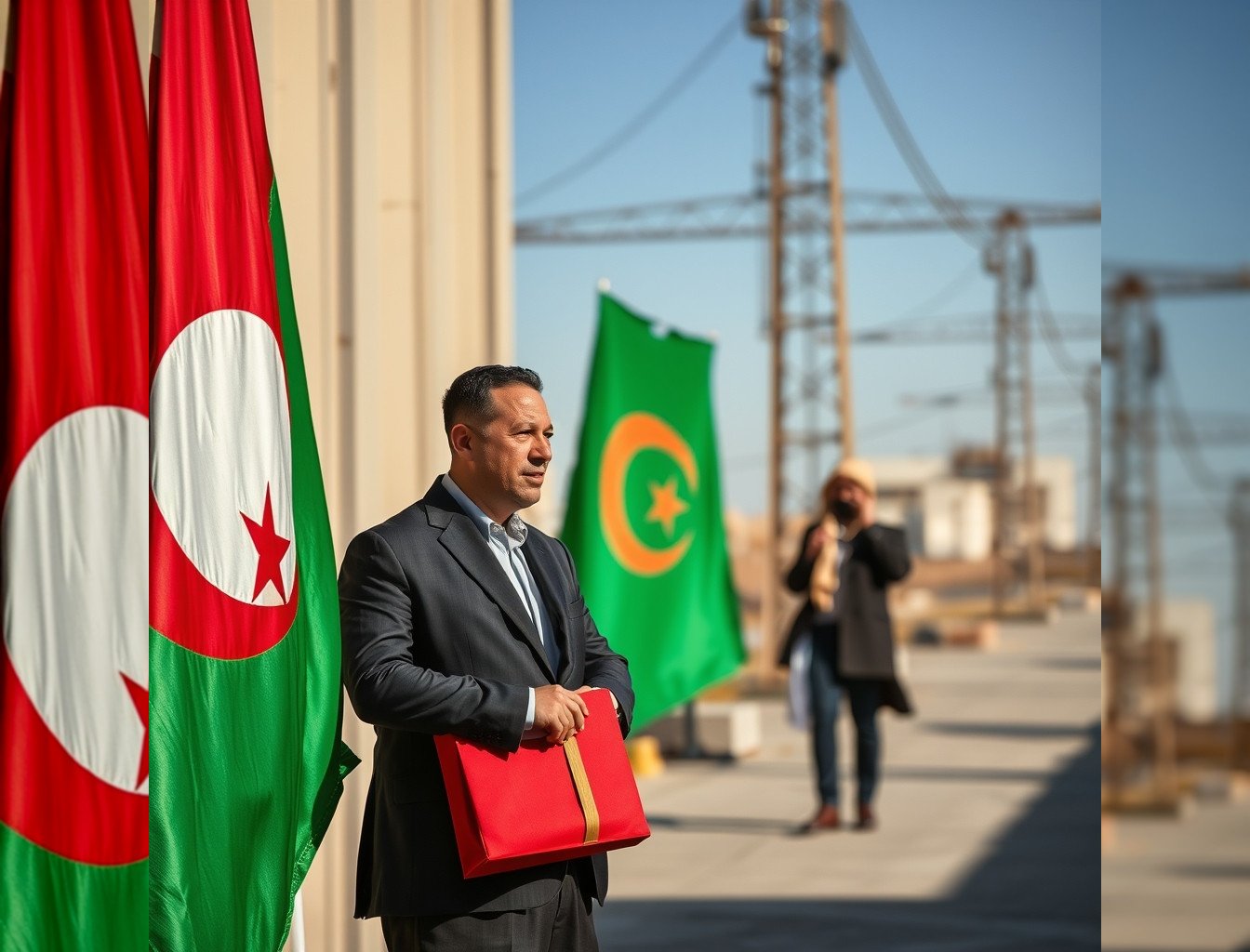
Algeria’s economic agenda this week centered on three themes: securing energy transition financing, managing structural constraints in SME lending, and accelerating urban and digital infrastructure. The government reaffirmed a $60 billion five-year energy investment plan, with green hydrogen as a priority, while acknowledging persistent natural gas production shortfalls. In urban planning, two major projects were launched in Algiers and Oran, including the country’s first AI data center. Simultaneously, SMEs face tighter bank financing conditions, food import costs rise due to drought, and Tunisia-Algeria trade talks remain stalled over unresolved tariffs. These developments intersect around three axes: energy-led fiscal spending, bureaucratic hurdles for private business, and climate-induced supply chain strains.
Energy Transition: $60 Billion Plan Faces Gas Reality Check
Algeria confirmed a five-year $60 billion investment program in renewable energy and gas infrastructure, targeting 30 GW of renewable capacity by 2030. The plan includes 15 GW of solar and 10 GW of wind, alongside green hydrogen pilot plants in Adrar and Hassi R’Mel. Oil Minister Mohamed Arkab stated that 40% of the funds will come from state-owned Sonatrach, 30% from international partners, and 30% from private investors.
However, Sonatrach’s gas production fell by 4% year-on-year in Q1 2024 to 11.2 billion cubic meters, below the 12 bcm target. Declining output at the Rhourde Nouss field and delays in the Hassi Berkin phase 2 project are cited as key constraints. The government has increased LNG exports to Europe by 12% since January 2024 but faces competition from U.S. and Qatari suppliers.
For entrepreneurs in the green sector, the plan offers two opportunities: subcontracting for Sonatrach’s renewable subsidiaries (Sonelgaz and New Energies Investment Company) and supplying components for hydrogen pilot projects. Tender documents for the Adrar green hydrogen plant are expected in Q3 2024. Meanwhile, foreign firms involved in gas exploration—such as Repsol and Eni—have delayed drilling due to bureaucratic delays in permit approvals.
SME Financing: Banks Tighten Credit Amid Risk Aversion
Local banks reduced SME loan disbursements by 8% in Q1 2024 compared to Q4 2023, according to the Bank of Algeria’s quarterly report. The non-performing loan ratio for SMEs rose to 15.3%, up from 14.1% in December 2023, driven by defaults in construction and trade sectors. Public banks—CPA, BNA, and BEA—accounted for 72% of the decline in SME lending.
The government’s new $500 million SME guarantee fund, launched in March 2024, has processed 1,247 applications but only approved 312, due to strict eligibility criteria. Applicants must show three years of tax compliance and a minimum turnover of 50 million Algerian dinars (≈$370,000).
For founders, access to finance remains split between state-backed schemes and high-cost private loans. The CPA’s “Moukawalati” program, which offers loans up to 10 million dinars at 6% interest, has a waiting list of 18 months. Alternative funding sources include Algerian business angels networks, which grew from 15 to 43 members in 2024, but total seed-stage investment remains below $10 million annually.
Climate & Agriculture: Drought Pushes Food Imports Higher
April 2024 temperatures in Algeria’s cereal belt (Tlemcen, Sidi Bel Abbès, Mascara) exceeded seasonal averages by 3–5°C, exacerbating drought conditions. The Ministry of Agriculture now forecasts a 22% shortfall in durum wheat production, down from 3.8 million tonnes in 2023 to 2.95 million tonnes. Imports for 2024 are projected at 5.1 million tonnes, a 15% increase from 2023, costing an estimated $1.8 billion.
The Green Dam initiative, launched in 1971 with a 1,500 km-long, 20 km-wide tree belt, has reaffirmed its role in mitigating soil erosion, but its impact on agricultural yields remains marginal. Current reforestation efforts focus on 40,000 hectares per year, primarily in Tiaret and Djelfa, with a budget of 12 billion dinars allocated for 2024.
For agribusinesses, the drought underscores the need for drought-resistant seed varieties and precision irrigation systems. The government’s 2025–2029 national water strategy includes subsidies of up to 70% for drip irrigation systems, capped at 5 million dinars per project. Exporters of processed foods (dates, olive oil) face higher input costs but benefit from weaker cereal prices in international markets.
Urban & Digital Infrastructure: Algiers and Oran Lead AI Push
President Abdelmadjid Tebboune presided over the inauguration of three projects in Algiers on June 15, 2024:
– A 500 MW gas-fired power plant in Koudiat Acerdoune, costing 42 billion dinars.
– A 20 km metro extension to El Harrach, with an investment of 38 billion dinars.
– A smart traffic management system using AI cameras across 12 districts.
In Oran, the Ministry of Digital Economy broke ground on a 20 MW AI data center, the first of its kind in Algeria. The facility will host government servers and serve as a commercial cloud hub, with Société Algérienne de l’Électricité et du Gaz (Sonelgaz) providing 60 GWh of annual power. Tender documents for hardware suppliers (servers, cooling systems) are expected by July 2024.
For tech entrepreneurs, the data center project opens opportunities in AI training, data labeling, and cybersecurity services. The National Cybersecurity Strategy 2025–2029 mandates that all public-sector cloud services use local data centers by 2027, creating a market of at least 150 billion dinars. However, talent shortages persist: Algeria has 12,000 ICT graduates per year, but only 3,000 meet industry standards for AI roles.
Tunisia-Algeria Relations: Trade Talks Hit Impasse
The 17th round of Algeria-EU trade negotiations stalled on June 16, 2024, over Algeria’s refusal to reduce tariffs on European industrial goods. Algeria demanded reciprocal concessions on agri-food exports, including olive oil and dates, which face EU sanitary barriers. No date has been set for further talks.
Meanwhile, the Intra-African Trade Fair (IATF2025) opened in Algiers on June 17, with Algeria pledging to eliminate 90% of tariffs on goods from African Union member states by 2027. However, trade with Tunisia remains constrained by Algeria’s 2021 decision to suspend preferential trade under the Agadir Agreement, citing dumping in pharmaceuticals and textiles.
For Algerian exporters, the EU impasse limits access to high-value markets, while African trade offers lower margins but fewer bureaucratic hurdles. Key export categories include construction materials (ceramics, steel), pharmaceuticals, and processed foods.
Political Dynamics: Leadership Changes amid Protests
The political bureau of the FLN (National Liberation Front) elected a new secretary-general on June 16, 2024, replacing Mohamed Ouyahia after 12 years. The new leader, 49-year-old former minister of trade Kamel Rezig, is the youngest to hold the post since 1988. Protests erupted in Algiers and Oran the same day, with demonstrators calling for broader political reforms. The government attributed the protests to “isolated groups” and did not announce any policy changes.
For businesses, the leadership change signals continuity in economic policy, as Rezig was a key architect of Algeria’s 2020 investment law. However, the protests underscore social tensions linked to youth unemployment (29.1% in Q1 2024) and housing shortages.
Medical Research: Cancer Ecosystem Takes Shape
Algeria’s first International Conference on Cancer Research concluded on June 14, 2024, with the launch of a national cancer research fund worth 5 billion dinars. The fund will finance 50 pilot projects in oncology, including partnerships with French and Italian institutes. Key focus areas: breast cancer (incidence rate: 38 per 100,000 women), pediatric oncology, and early detection programs.
For biotech startups, the fund offers grants of up to 20 million dinars for diagnostic tool development. However, local production of oncology drugs remains limited: Algeria imports 85% of its cancer medications, with a bill of $420 million in 2023.
Key takeaway for entrepreneurs
Sources
- AL24 News
- ASHARQ AL-AWSAT English
- The Banker magazine
- The Borgen Project
- Africa24 TV
- We are Tech
💡 Starting a business in Algeria? GlobalStart guides you step by step: procedures, real costs, company forms (SARL, EURL, SPA) and CNRC registration.