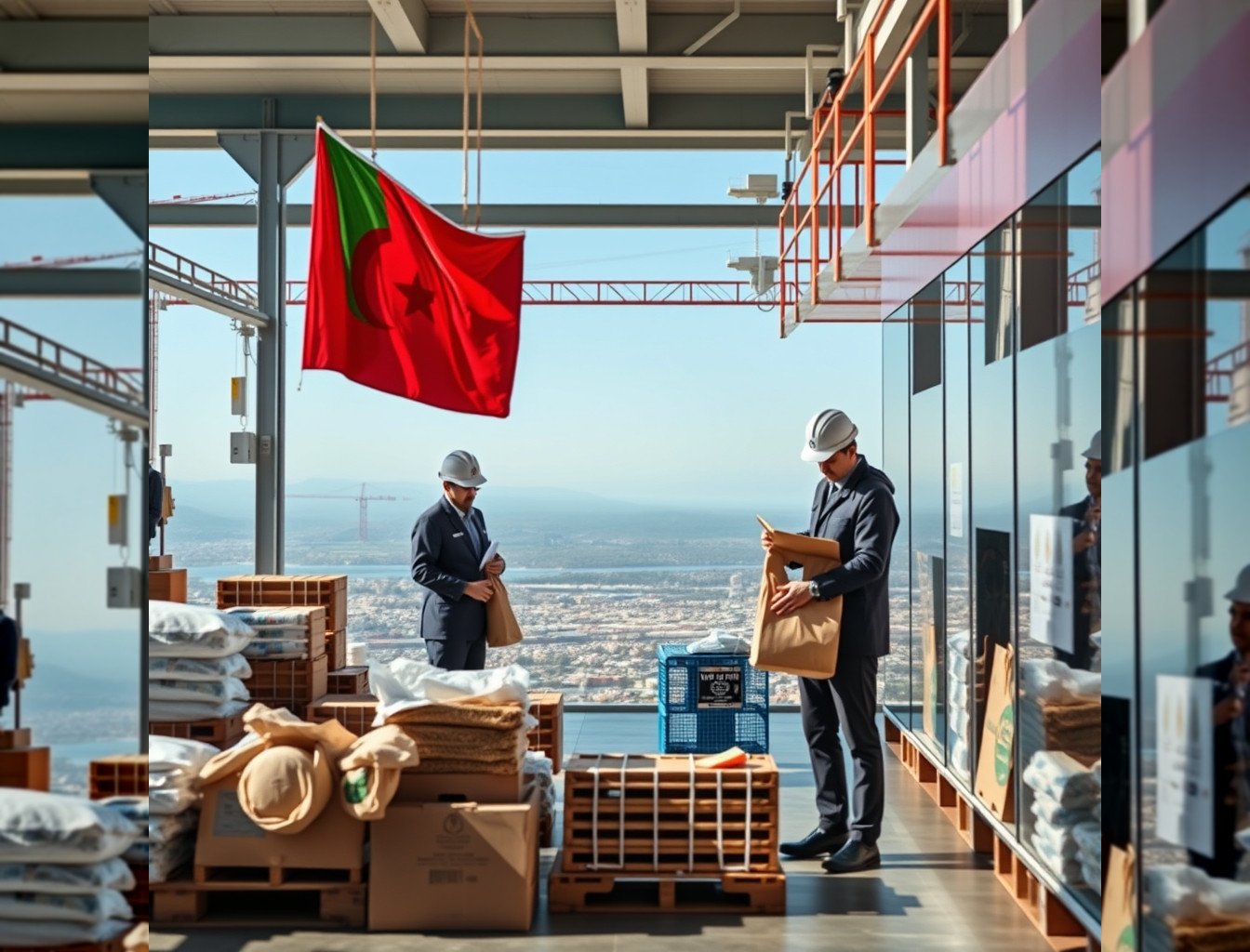
Algeria’s non-hydrocarbon exports reached $4.3 billion in 2025, a 26 percent jump from the previous year, according to AL24 News. For entrepreneurs and founders inside the country and across the diaspora, this expansion signals new opportunities at a time when the government is pushing to diversify an economy still dominated by oil and gas. The rise is driven by industries that can quickly expand capacity—agro-processing, pharmaceuticals, construction materials and light manufacturing. Figures provided by Algerian customs show that processed foods accounted for the largest single slice, followed by basic pharmaceuticals and textiles. Observers note these sectors require relatively low capital to start, making them accessible to first-time founders and returning entrepreneurs with limited budgets.
Inside Algeria, business creators are responding. In Oran’s industrial zone, a cohort of thirty start-ups opened shop in the last twelve months, all focused on packaging and exporting preserved vegetables and dates. One founder, Yacine Belaid, told local media his company now ships 40 containers of fig jam to West Africa each quarter, up from ten the previous year. “The paperwork is still slow,” Belaid said, “but once you have the first orders, banks talk differently and suppliers give better terms.” His experience illustrates how export momentum can cascade into easier financing and supplier networks, two bottlenecks that have long hemmed in Algerian start-ups.
Diaspora entrepreneurs are also seizing the moment. Rabah Khelif, who runs a small spices business from Montreal, recently opened a packaging facility in Tipaza. He imports Algerian cumin and paprika from cooperatives in Béchar and repackages them for North American halal food distributors. Khelif cites two drivers: Algeria’s new export subsidy program, which reimburses 7 percent of shipping costs for non-hydrocarbon goods, and the weaker dinar, which makes Algerian packaging cheaper for foreign buyers. “With the currency at 145 dinars to the euro, our margin on each box is 15 percent higher than two years ago,” he calculates. Khelif’s case shows how exchange-rate shifts can turn niche products into profitable lines when global buyers are price-sensitive.
The numbers back up the trend. Pharmaceutical exports, for example, rose from $120 million in 2024 to $210 million in 2025, according to Algeria’s Customs Directorate. Most of the growth came from generic medicines produced under contract for European and sub-Saharan markets. Walid Cherfaoui, CEO of PharmaLab in Sétif, says he tripled his workforce last year after landing a three-year supply deal with a German distributor. “We needed ISO certification and EU-GMP compliance,” Cherfaoui explained, “but the export agency in Algiers moved our file in six weeks once we showed the order.” This suggests that government agencies are accelerating approvals when orders are already secured, a useful signal for founders who fear bureaucratic delays.
Construction materials are another bright spot. Exports of tiles, steel fittings and insulation jumped 45 percent, driven by demand from neighboring Sahel countries rebuilding after droughts. In Tlemcen, entrepreneur Amina Benali converted a 20-year-old ceramics plant to produce frost-resistant tiles for Mali and Niger. “We bought second-hand German kilns at half price,” she said. “With container freight falling 12 percent since mid-2025, our landed cost in Bamako is competitive with Turkish suppliers.” Benali’s story shows how older industrial assets can be retooled quickly when demand shifts.
Yet challenges remain. Customs clearance still averages ten days for exports bound for sub-Saharan Africa, compared with six days for Mediterranean routes, according to the Algerian Exporters’ Federation. And while the 7 percent shipping subsidy helps, entrepreneurs say it rarely covers the full cost of air freight for high-value goods. Still, the overall trajectory is clear: non-hydrocarbon exports are growing faster than the economy’s overall 3.8 percent expansion in 2025, a rare divergence that creates space for new entrants.
Key takeaway for entrepreneurs
Algeria’s 26 percent jump in non-hydrocarbon exports in 2025—led by processed foods, pharmaceuticals and construction materials—offers export-ready founders a faster path to revenue. The weaker dinar and new shipping subsidies improve margins for diaspora-linked products sold abroad. Priority sectors include agro-processing, generic medicines and frost-resistant building materials, where existing factories can be retooled with modest capital.
Sources
- Arab News
- Trendsnafrica
- AL24 News
- World Bank Group
💡 Starting a business in Algeria? GlobalStart guides you step by step: procedures, real costs, company forms (SARL, EURL, SPA) and CNRC registration.