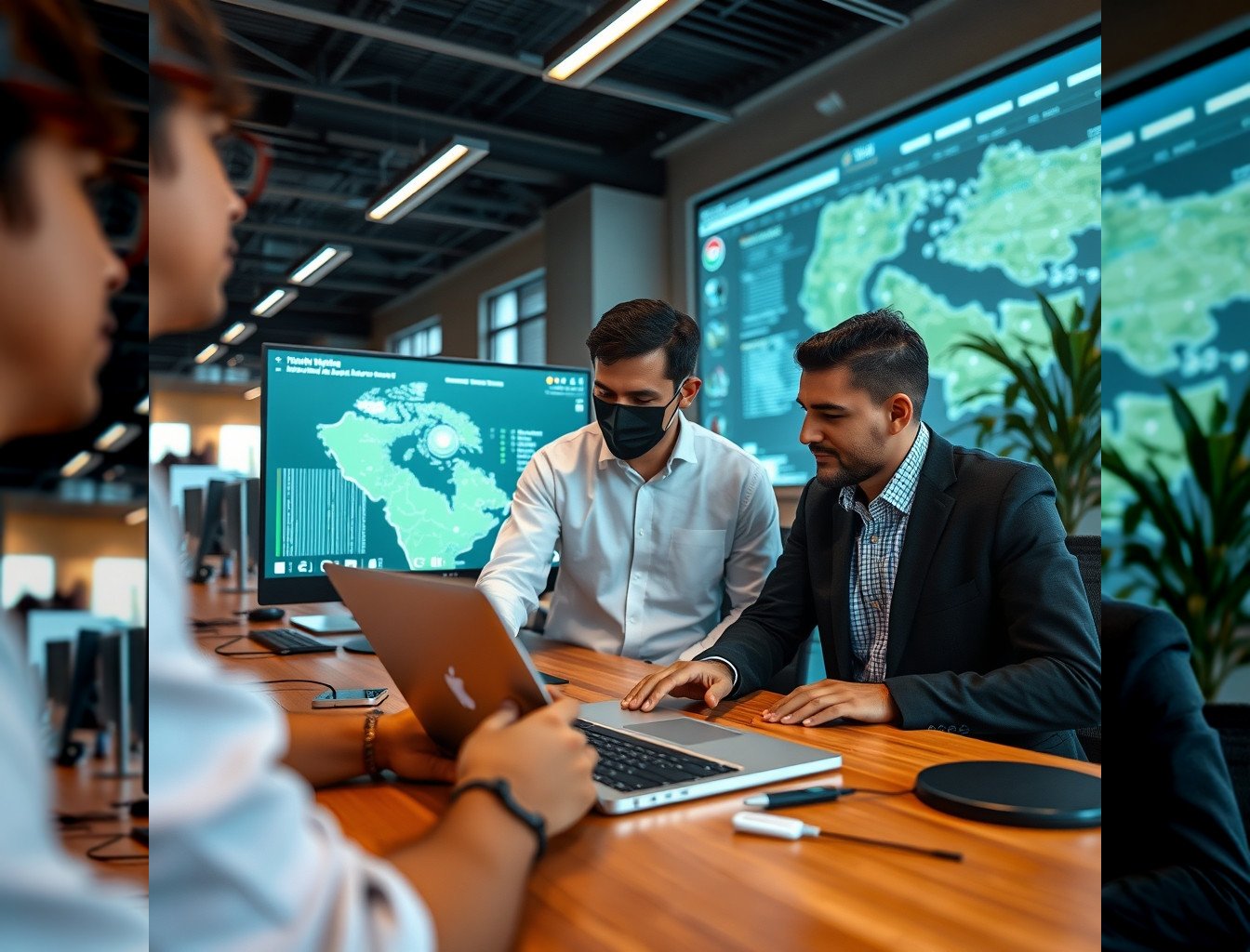
This week Algeria’s government opened the National AI and Virtual Learning Centre in Algiers, a 24-month-old project now operational on the city’s Bab Ezzouar technology park. The centre, whose director is Professor Amina Benali, will train 50 000 engineers and founders in artificial-intelligence skills by 2030, while simultaneously hosting Algeria’s first national AI accelerator that has already accepted 220 startups since January 2026. “We are not building a lab; we are building an industry,” Benali told reporters outside the centre’s glass façade last Thursday.
The centre is the public face of a wider AI roadmap adopted by President Abdelmadjid Tebboune in 2025 and formally published by the Ministry of Digital Economy in Algiers in July 2026. The roadmap assigns four core missions: train 50 000 AI-literate professionals, fund 20 000 tech startups by 2029, localise at least 30 per cent of Algeria’s AI software stack within five years, and raise the digital sector’s share of gross domestic product from 3.2 per cent today to 7 per cent by 2030. According to the Ministry’s latest dashboard, the country has already registered 560 AI-related projects this year, up from 112 in 2024.
For entrepreneurs, the centre’s most immediate lever is the accelerator programme that grants each cohort up to 20 million Algerian dinars (≈ 145 000 US dollars) in non-dilutive grants and zero-interest loans repayable over seven years. Twenty-two companies have completed the first two cohorts; two graduates, DeepGreen Agritech and NeuroLink Security, have already raised additional capital from Algiers-based venture funds. NeuroLink’s CEO, Yacine Touati, says his company cut its time-to-market for an AI-driven fraud-detection engine from twenty-four to six months thanks to the centre’s cloud credits and mentorship from Sonatrach’s digital innovation lab.
The accelerator is only one pillar of the broader push to eliminate the bottlenecks that have historically stifled Algerian startups. Last February the Ministry of Finance in Algiers waived listing fees on the Algiers Stock Exchange for companies younger than five years and with a market capitalisation under 1 billion dinars. Since the waiver took effect, the exchange has onboarded eight new venture-class companies in cloud security, ed-tech and fintech, raising 4.3 billion dinars in fresh equity. “The fee holiday removes the single largest psychological barrier founders cite when they consider going public,” says Dalila Hamidi, head of listing at the Bourse d’Alger.
At the same time, the National Digital Services Centre launched in July 2026—directed by Kamel Hachemi—is building a national data-sovereignty stack. The centre’s first product, a government-grade large-language model called “AlgerLM”, is already powering six ministries’ citizen-facing chatbots, including those of the Ministries of Health and Energy. By the end of 2026 the model will be open-sourced under an Algerian licence, allowing startups to fine-tune it for their own verticals without royalty payments. “We are creating a commons that any Algerian entrepreneur can exploit,” Hachemi told a press briefing in Algiers on 7 July 2026.
For the Algerian diaspora, the AI roadmap offers a new return channel. A dedicated “Diaspora Entry Visa” programme, piloted by the Ministry of Foreign Affairs in Algiers, fast-tracks residency for founders with at least three years of professional experience in an OECD country. In the first six months of the programme, 117 founders have relocated, bringing an estimated 38 million euros of seed capital and 240 new high-skill jobs. One returnee, Sadek Boulakhras—who spent five years in Montreal building an AI diagnostics startup—has already launched MedIQ Health, a tele-radiology venture that secured 80 million dinars from the National Investment Fund in May 2026.
Not all the numbers are positive. Official data show that only 14 per cent of women-led startups have accessed the AI accelerator’s grants, despite a dedicated 30 per cent quota. Professor Benali admits the centre needs to “translate its targets into actionable programmes” for female founders. Likewise, the Bourse d’Alger’s fee waiver does not cover the 9 per cent capital-gains tax on exits, a clause that some fund managers say still discourages later-stage investors.
Still, the momentum is undeniable. The World Bank’s latest country economic memorandum, published in Algiers in December 2024, estimates that every 1 per cent increase in Algeria’s digital density adds 0.3 percentage points to annual GDP growth. With the AI roadmap targeting a 7 per cent digital share within five years, the arithmetic points to a potential 2.1-percentage-point boost—roughly 1.7 billion dollars per year at today’s prices.
Key takeaway for entrepreneurs: Algeria’s AI push combines grants, open models and visa incentives to cut the cost and time of launching an AI venture. Women founders remain under-represented, and tax on exits persists, but the ecosystem now offers non-dilutive capital, sovereign data tools and a clear path to scale for founders based in Algiers or abroad.
Sources
- World Bank Blogs
- Muslim Network TV
- ITWeb Africa
- We are Tech
- TechAfrica News
- AL24 News
💡 Starting a business in Algeria? GlobalStart guides you step by step: procedures, real costs, company forms (SARL, EURL, SPA) and CNRC registration.