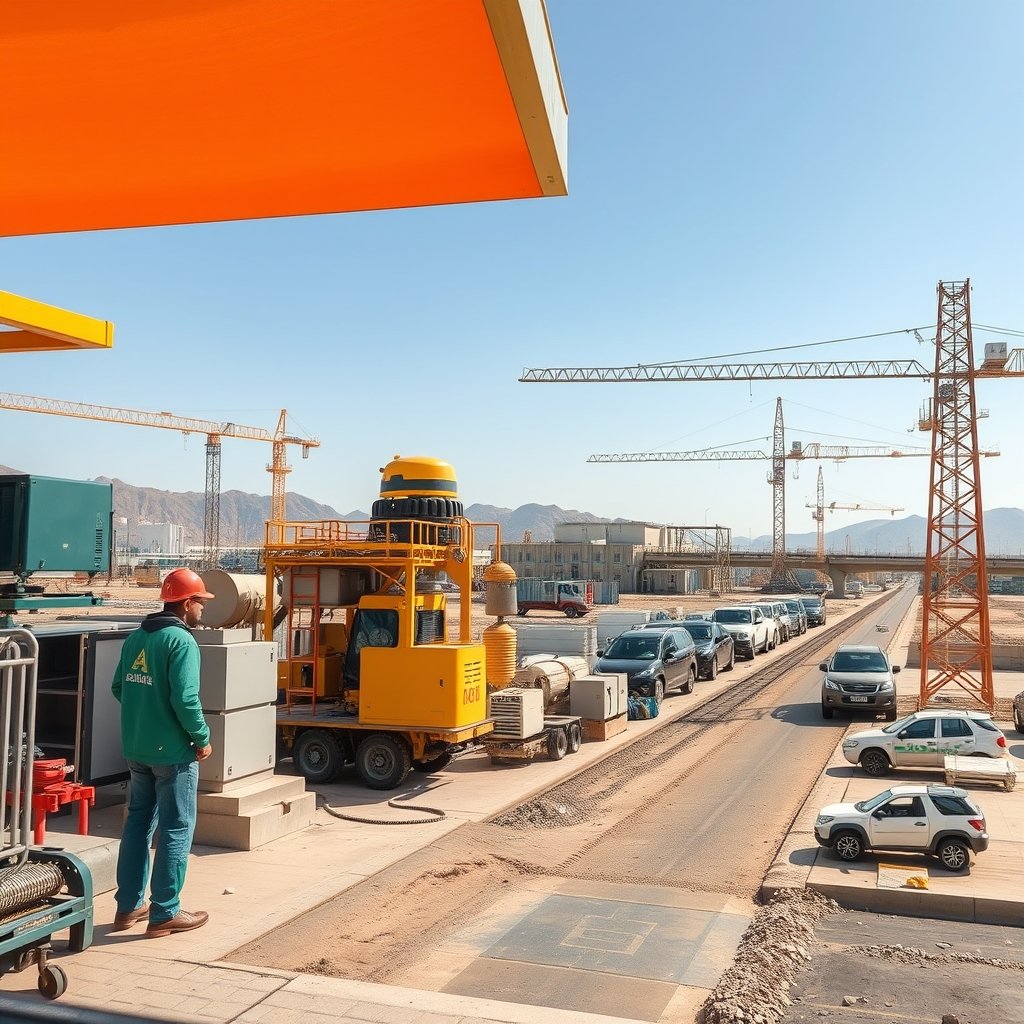
This week’s developments show three converging trends. First, Algeria secured new industrial projects in automotive, energy and tire manufacturing. Second, the state accelerated digital integration of public services and school construction. Third, infrastructure projects advanced with a focus on logistics and wastewater treatment. Cultural initiatives remained state-led, with no direct economic impact reported.
Automotive and tire production ramp up
Opel confirmed plans to produce vehicles and engines in Algeria. No timeline or investment figures were disclosed. The project follows Algeria’s 2023 automotive decree, which mandates 15% local integration for imported vehicles and 40% for locally assembled ones. Opel’s move aligns with the government’s target to reduce car imports, which reached $1.2 billion in 2023.
Separately, Algeria laid the foundation for its third tire plant. The facility, located in the industrial zone of Relizane, will have an annual capacity of 2.5 million tires. It joins two existing plants: one in Tiaret (1.5 million tires/year) and another in Sétif (1 million tires/year). The new plant will supply both domestic and African markets. Algeria’s tire market is valued at $400 million annually, with 60% still imported.
Germany turns to Algeria for hydrogen supply
Germany’s interest in Algerian hydrogen stems from the country’s gas infrastructure and renewable energy potential. Algeria has 15,000 km of gas pipelines, including the Trans-Mediterranean Pipeline to Italy and the Medgaz line to Spain. The government estimates solar and wind capacity at 10 GW, with plans to reach 22 GW by 2030.
Algeria’s hydrogen strategy targets 10 GW of electrolysis capacity by 2040. The state-owned Sonatrach and Germany’s Fraunhofer Institute signed a memorandum in 2023 to study feasibility. No binding contracts have been announced. Algeria’s proximity to Europe—shorter shipping routes than Australia or Chile—reduces transport costs by 30-40%.
Digital services expand in energy sector
Algeria’s national digital services portal, service-public.dz, added six new energy-related services. These include:
– Online applications for solar panel installation permits
– Gas connection requests for industrial zones
– Electricity subsidy claims for agricultural pumps
The portal processed 1.8 million requests in 2023, up from 900,000 in 2022. The energy sector accounts for 22% of all digital transactions. The government aims to digitize 80% of public services by 2025. Entrepreneurs can now submit permits without in-person visits, reducing processing time from 30 to 10 days.
School construction accelerates
The Ministry of National Education announced 385 schools will be delivered by December 31, 2024. This follows 2,100 schools built in 2023. The 2026-2027 school year preparations include:
– Recruitment of 30,000 new teachers
– Expansion of vocational training centers in 12 wilayas
– Introduction of coding and robotics programs in 500 secondary schools
Algeria’s education budget for 2024 is DZD 1.2 trillion ($8.8 billion), 18% of total public spending. The government targets a 25% increase in STEM graduates by 2027. Private education providers, currently 5% of the market, are not part of the expansion plan.
Infrastructure projects target African trade
Algeria is positioning itself as a logistics hub for sub-Saharan Africa. Key projects include:
– Expansion of the Port of Djen Djen, with a new container terminal (capacity: 1.5 million TEUs/year)
– Construction of a 1,200 km trans-Saharan highway linking Algeria to Nigeria
– Upgrade of the Béchar-Tindouf rail line to transport iron ore from Gara Djebilet
The trans-Saharan highway, 85% complete, will reduce transport time from Algiers to Lagos from 10 to 5 days. Algeria’s trade with Africa reached $5.2 billion in 2023, up 12% year-on-year. The government offers tax exemptions for logistics companies operating in southern wilayas.
Wastewater treatment capacity grows
Algeria is building 200 new wastewater treatment plants by 2026. The country currently has 180 plants, treating 1.2 billion cubic meters annually. The new facilities will add 800 million cubic meters of capacity. The government’s 2024-2028 water plan allocates DZD 1.5 trillion ($11 billion) to water projects.
Private operators can bid for build-operate-transfer (BOT) contracts. The first BOT plant, in Oran, was awarded to a Spanish-Algerian consortium in 2023. Treated wastewater will be used for irrigation, reducing agricultural water consumption by 30%. Algeria’s agricultural sector accounts for 60% of total water use.
Cultural initiatives remain state-driven
The Ministry of Religious Affairs and Endowments highlighted the role of Sira (Prophet Muhammad’s biography) in promoting social cohesion. No economic programs were linked to the initiative. Separately, the ministry received winners of the King Abdulaziz International Quran Recitation Competition. The event had no reported impact on tourism or business.
Law enforcement dismantled an international drug trafficking network. Authorities seized 10 million psychotropic pills and 33 kg of cocaine. The operation involved cooperation with European agencies. No connection to legal pharmaceutical or logistics sectors was mentioned.
Week’s balance
– Industrial projects: Opel’s vehicle production, third tire plant, hydrogen cooperation with Germany.
– Digital services: Six new energy sector services added to service-public.dz.
– Education: 385 schools to be delivered by year-end; 30,000 new teachers recruited.
– Infrastructure: Logistics hub expansion, trans-Saharan highway progress, wastewater treatment capacity increase.
– Culture: State-led initiatives with no direct economic impact.
Key takeaway for entrepreneurs
Algeria’s industrial and infrastructure projects create supply chain opportunities in automotive, energy and logistics. Digital service expansion reduces administrative delays for permits and subsidies. Entrepreneurs can bid for BOT contracts in wastewater treatment and target African markets via new transport corridors.
Sources
- APS English
- Media Stellantis
- RFI
💡 Starting a business in Algeria? GlobalStart guides you step by step: procedures, real costs, company forms (SARL, EURL, SPA) and CNRC registration.