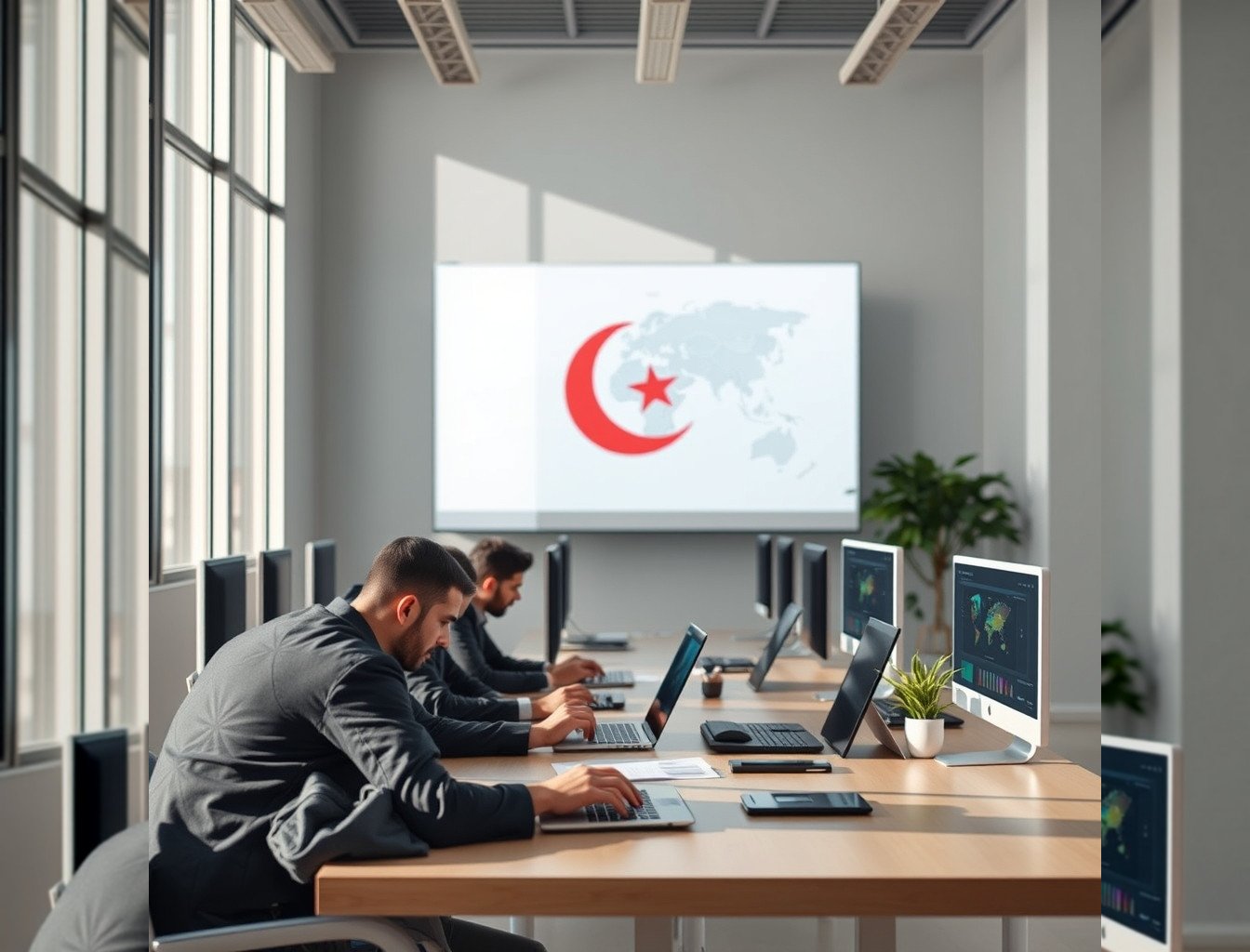
Algeria has launched its first startup cluster dedicated to artificial intelligence and cybersecurity, a move that signals a strategic pivot toward high-value sectors in a nation long dependent on hydrocarbons. The announcement, made in April 2026 by the Ministry of Knowledge Economy and Startups, follows a recent $5 million Series A funding round by VOLZ, Algeria’s largest ever startup investment, and comes as international lenders approve billions for infrastructure projects across the country.
The new cluster, located in the Sidi Abdellah technopark near Algiers, aims to incubate 50 AI-driven startups over three years and train 3,000 engineers in machine learning and cybersecurity. According to Soumia Benkhaled, Minister of Knowledge Economy and Startups, Algeria will allocate 1.2 billion Algerian dinars (about $9 million) annually to subsidize office space, cloud computing credits, and salaries for qualified engineers working in resident startups. The cluster is modeled on Tunisia’s Carthage Valley and Morocco’s Casablanca Finance City, but with a focus on French-speaking African markets and Europe.
One of the first tenants is VOLZ, a B2B logistics platform that uses AI to optimize freight matching between Algerian importers and European exporters. VOLZ raised $5 million in August 2026 from Algerian private equity firm Sarost and French venture capital group Partech, valuing the company at $22 million. The startup plans to hire 80 engineers at the cluster by 2027 and expand into Morocco and Ivory Coast. “We chose Algeria because the government is finally treating software as an export product,” said VOLZ co-founder Yacine Taleb at a press conference in Algiers.
The cluster is part of a broader national strategy to diversify the economy and reduce youth unemployment, which stood at 28.3 percent in 2025. Algeria’s non-oil exports reached $3.4 billion in 2025, up from $2.1 billion in 2023, driven mainly by pharmaceuticals and agri-food products. But the government now sees digital services as the next frontier. The African Development Bank approved an $878 million loan in July 2026 to expand the Laghouat–Ghardaïa–El Meniaa railway, which officials say will cut transport costs for tech firms exporting digital services to Europe via fiber-optic links through Oran.
For Algerian entrepreneurs in the diaspora, the cluster offers a concrete on-ramp to return home. Fatima Zohra Benali, a former AI researcher at Google in Paris, registered a company called NeuroFlow in March 2026 to develop Arabic-language speech recognition software. “The cluster gave me a 12-month tax holiday and a 50 percent subsidy on office rent,” she said. “That’s enough runway to test a product in Algeria before scaling to the Maghreb.”
Local investors are also warming up. The state-backed Algerian Investment Fund (FAIE) has pledged to co-invest up to $15 million in AI startups within the cluster, with a focus on cybersecurity for critical infrastructure. In parallel, Algeria’s largest bank, BNA, launched a $20 million venture debt line for tech firms in 2025, targeting companies with at least 30 percent export revenue.
The technopark sits inside a 70-hectare campus that includes a data center operated by Algeria’s national telecom incumbent, Algérie Télécom. The center provides startups with Tier-3 compliant cloud hosting at subsidized rates, a critical advantage in a country where internet bandwidth costs are among the highest in North Africa.
Yet challenges remain. Algeria’s foreign exchange controls still require startups to convert export earnings into dinars within 30 days, which can delay reinvestment. And while the cluster offers visas for foreign talent, bureaucratic delays persist. “We brought in a French engineer, but his work permit took six months,” said an executive at an AI cybersecurity firm operating from the cluster.
Despite these hurdles, the government is pushing ahead. In a speech in Oran last month, Prime Minister Nadir Larbaoui announced a “digital export corridor” linking the Sidi Abdellah cluster to the port of Oran, cutting the time to ship servers and hardware to Europe by 40 percent.
For Algerian entrepreneurs at home and abroad, the cluster is more than a building—it’s a policy signal that software and data can now be treated as strategic exports, eligible for the same privileges as liquefied natural gas. With $5 million already deployed by VOLZ and $9 million in annual state subsidies flowing to resident startups, the question is no longer whether the ecosystem can grow, but how fast.
Key takeaway for entrepreneurs:
The AI and cybersecurity startup cluster in Sidi Abdellah offers 50 subsidized slots, $9 million in annual state support, and a path to export digital services. Algerian diaspora founders can return with tax holidays and co-investment from the Algerian Investment Fund. Access to Tier-3 data hosting and a new digital export corridor to Oran reduces operational friction for early-stage tech firms.
Sources
- TechNext.ng
- GrantWatch
- Tech In Africa
- We are Tech
- fundsforNGOs News
- Business Insider Africa
💡 Starting a business in Algeria? GlobalStart guides you step by step: procedures, real costs, company forms (SARL, EURL, SPA) and CNRC registration.