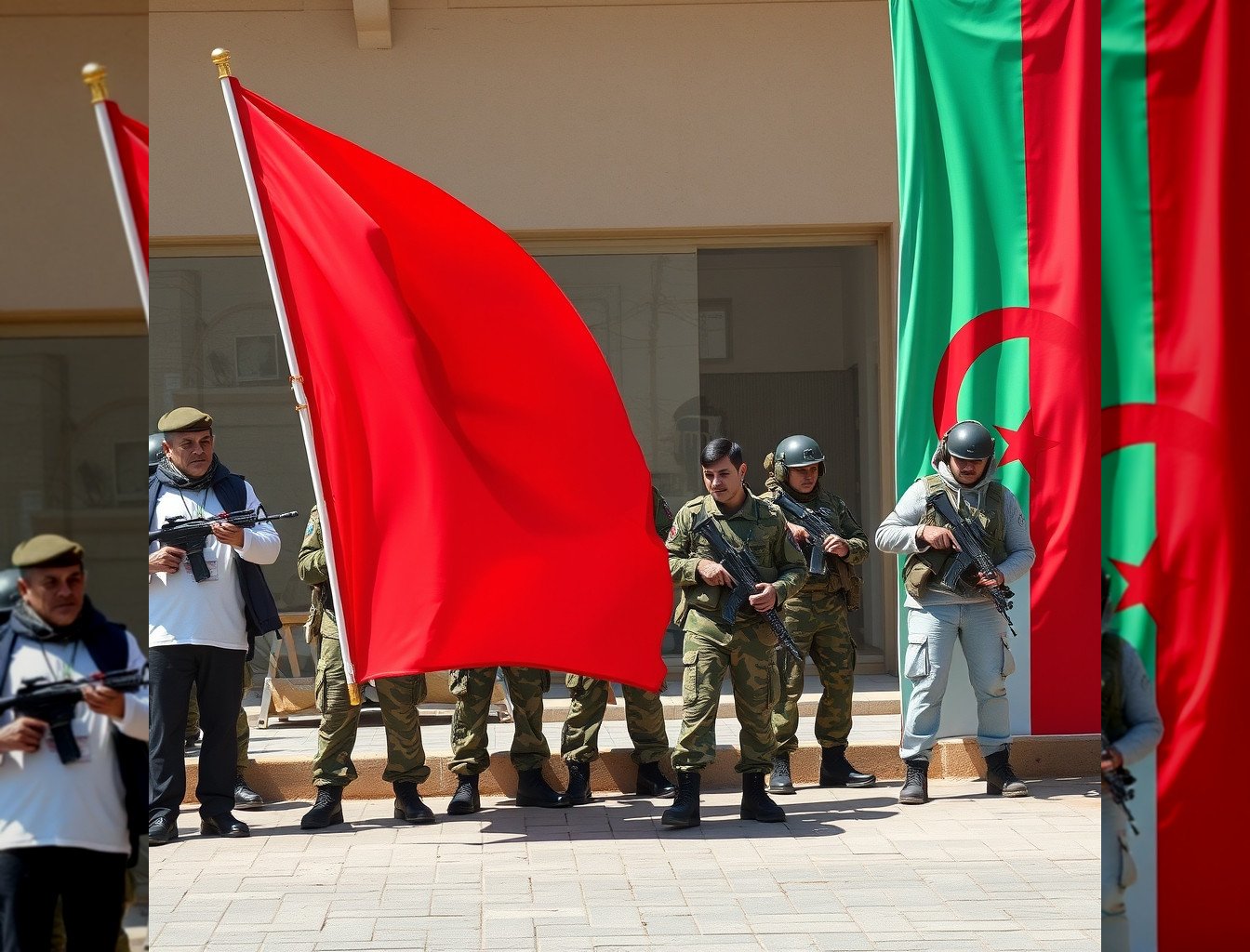
Military and geopolitics: arms imports rise while Sahel ties deepen
Algeria finalized a military hardware exchange with Niger this week, delivering four helicopters as part of a broader alignment with the Russia-backed Sahel alliance. The transfer follows the first foreign deployment of Russia’s Su-34E and Su-57E fighters, with images confirming Algerian insignia on the aircraft. In parallel, Turkey’s potential exit from the S-400 program and its bid to re-enter the F-35 consortium have renewed speculation about Algerian procurement options, though no official tender has been published.
Defense spending remains Algeria’s top public outlay for 2026. According to the latest national budget draft, military allocations will again exceed infrastructure and social sectors, matching Ukraine’s share of public expenditure in 2025. The Maghreb defense-spending comparison shows Algeria at 3.7% of GDP versus Morocco’s 3.3% and Tunisia’s 2.1%.
For entrepreneurs in logistics or subcontracting, sustained arms imports imply steady demand for specialized transport, warehousing, and maintenance services. Firms with security clearances or dual-use certifications should monitor upcoming tenders linked to aircraft, helicopters, and radar systems.
Gender policies: shelters absent despite legal pledges
Twenty-two years after a 2005 law mandated national shelters for survivors of gender-based violence, authorities have yet to operationalize the network. A UN-backed assessment this week found that only 3 of 48 provinces host functioning safe houses, with access restricted by bureaucratic hurdles and underfunded budgets. Domestic violence awareness campaigns have expanded via NGOs, but legal protection remains piecemeal, with only 12 of Algeria’s 58 wilayas adopting local bylaws.
The gap persists despite a 22% year-on-year increase in reported domestic violence cases in 2026, according to the Ministry of National Solidarity. Entrepreneurs in social services can target donor-funded projects for shelter management, counseling, and digital case-tracking systems, but must navigate provincial-level approvals and security vetting.
Tramway and industry: localizing metal parts production
Sifi Ghrieb Group launched a Batna-based factory to produce metal components via molding, with an initial capacity of 5,000 tons per year. The project targets local tramway suppliers and public-works contractors, aiming to reduce imports of aluminum and steel parts by 18% within three years. The factory will employ 120 workers and requires 4.2 MW of power, sourced from the national grid.
For downstream manufacturers, the plant’s output opens opportunities for just-in-time deliveries to rail and urban-transport projects. Suppliers of raw materials—steel coils, aluminum billets, and lubricants—should prepare capacity expansions given expected procurement tenders.
Universities: English replaces French as instruction language
Algeria’s Ministry of Higher Education announced the phased replacement of French with English as the primary language of instruction in technical, scientific, and business faculties starting the 2027–2028 academic year. Pilot programs will begin in September 2026 at 12 universities, including Algiers, Oran, and Constantine. The shift affects 230,000 students in engineering, medicine, and economics programs, with an estimated retraining cost of 3.8 billion dinars (USD 28.5 million) for faculty and teaching materials.
The decision follows a 2024 pilot where 1,200 students in computer science at Blida University completed coursework in English without measurable drop in exam pass rates. Publishers report orders for 180,000 English-language textbooks, with procurement open to domestic and international suppliers.
For edtech startups, the transition creates demand for digital English-learning platforms, translation services, and bilingual courseware. Language schools should expect increased corporate training contracts targeting university faculty and mid-career professionals.
Education watch: Hirak’s academic shadow
One year after the Hirak protest movement’s resurgence, universities remain hubs of low-level activism. 14 student unions were suspended in June 2027 for organizing unauthorized gatherings, while 27 faculty members face disciplinary review for alleged political statements. Simultaneously, 18 political prisoners arrested during 2019–2021 protests were released under presidential pardon, including five university lecturers.
For entrepreneurs in student services—housing, transport, and digital campus tools—the periodic unrest suggests a need for flexible booking systems and remote-learning modules to mitigate disruption.
Army operations: migrant smuggling crackdown intensifies
Between June 29 and July 3, the Algerian Army reported nine arrests in a cross-border operation targeting migrant-smuggling networks operating between Tlemcen and the Spanish enclave of Melilla. Separately, 18 Moroccan nationals were detained in Tindouf for alleged coordination with trans-Saharan routes. The Interior Ministry stated 41 trafficking cells have been dismantled nationwide since January 2027.
For logistics and border-security firms, ongoing enforcement heightens demand for biometric screening systems, drone surveillance, and secure detention facilities.
Public works: Chinese investments and port expansion
Algeria and China marked 30 years of diplomatic ties with a cultural showcase in Algiers, coinciding with broader economic talks. Chinese state-owned firms are expected to finalize USD 2.3 billion in industrial investments by Q4 2027, including a 500 MW solar farm in Ouargla and a fertilizer plant in Arzew with annual capacity of 600,000 tons.
CMA CGM confirmed it is evaluating a USD 450 million port terminal investment in Algiers, part of a regional hub strategy that would increase container throughput from 1.2 million TEUs in 2026 to 1.8 million by 2030. The project requires dredging, customs automation, and bonded-warehouse infrastructure.
Algeria’s ranking as one of Africa’s top investment destinations in 2025—Algiers and Constantine placed in the top 10—reflects port expansion plans. Real-estate developers in logistics zones should anticipate rising demand for warehouse space within 50 km of port gateways.
Cities and diplomacy: cultural friction and anniversaries
Algeria celebrated 65 years of independence on July 5, 2027, with national events in Algiers, Oran, and Tizi Ouzou. Kazakhstan staged a cultural showcase in Algiers to commemorate three decades of bilateral ties, including exhibitions, film screenings, and business forums focusing on mining and agribusiness.
A diplomatic row emerged at UNESCO when Morocco rebuked Algeria over “unacceptable conduct” during a cultural event in Paris, where Algerian officials allegedly overshadowed Morocco’s presentation. No formal sanctions were imposed.
For event organizers and hospitality providers, national commemorations create short-term spikes in demand for venues, translation services, and security staffing.
ECOWAS and regional energy: pipeline and union dynamics
The proposed USD 26 billion Nigeria-Morocco gas pipeline resurfaced this week, with Algerian officials reiterating their preference for trans-Saharan routes that would include Algerian territory. The Arab Maghreb Union, long dormant, remains defunct; Algeria has not ratified any new agreements under the framework since 2015.
Bilateral talks between Algeria’s foreign minister and counterparts from Chad, Niger, and Mali focused on security and trade corridors, with no new energy agreements announced. Entrepreneurs in renewable energy should monitor trans-Saharan interconnection proposals, as Algeria’s grid could serve as a transit hub for solar-generated electricity.
Balance of the week
– Defense: New helicopter deliveries, fighter deployments, and budget dominance.
– Industry: First local tramway parts plant in Batna, capacity 5,000 tons/year.
– Education: English language shift for 230,000 students; retraining budget 3.8 billion dinars.
– Foreign policy: Russia-backed Sahel alignment; cultural diplomacy with Kazakhstan.
– Public works: USD 2.3 billion Chinese investments; CMA CGM evaluating USD 450 million port terminal.
– Gender: Shelter shortfall persists after 22 years despite violence reporting rise.
Key takeaway for entrepreneurs: Track English-language textbook tenders, port logistics RFIs, and Chinese-funded industrial projects. Monitor Algeria’s Sahel security posture for transport and surveillance subcontracting. Plan for bilingual faculty retraining and textbook localization pipelines starting 2026.
Sources
- Stimson Center
- The Libya Observer
- Caspian Post
- National Today
- The International Institute for Strategic Studies
- Atalayar
💡 Starting a business in Algeria? GlobalStart guides you step by step: procedures, real costs, company forms (SARL, EURL, SPA) and CNRC registration.