“`markdown
## SMART TUNISIE’s Dominance Masking a Broader Market Slowdown
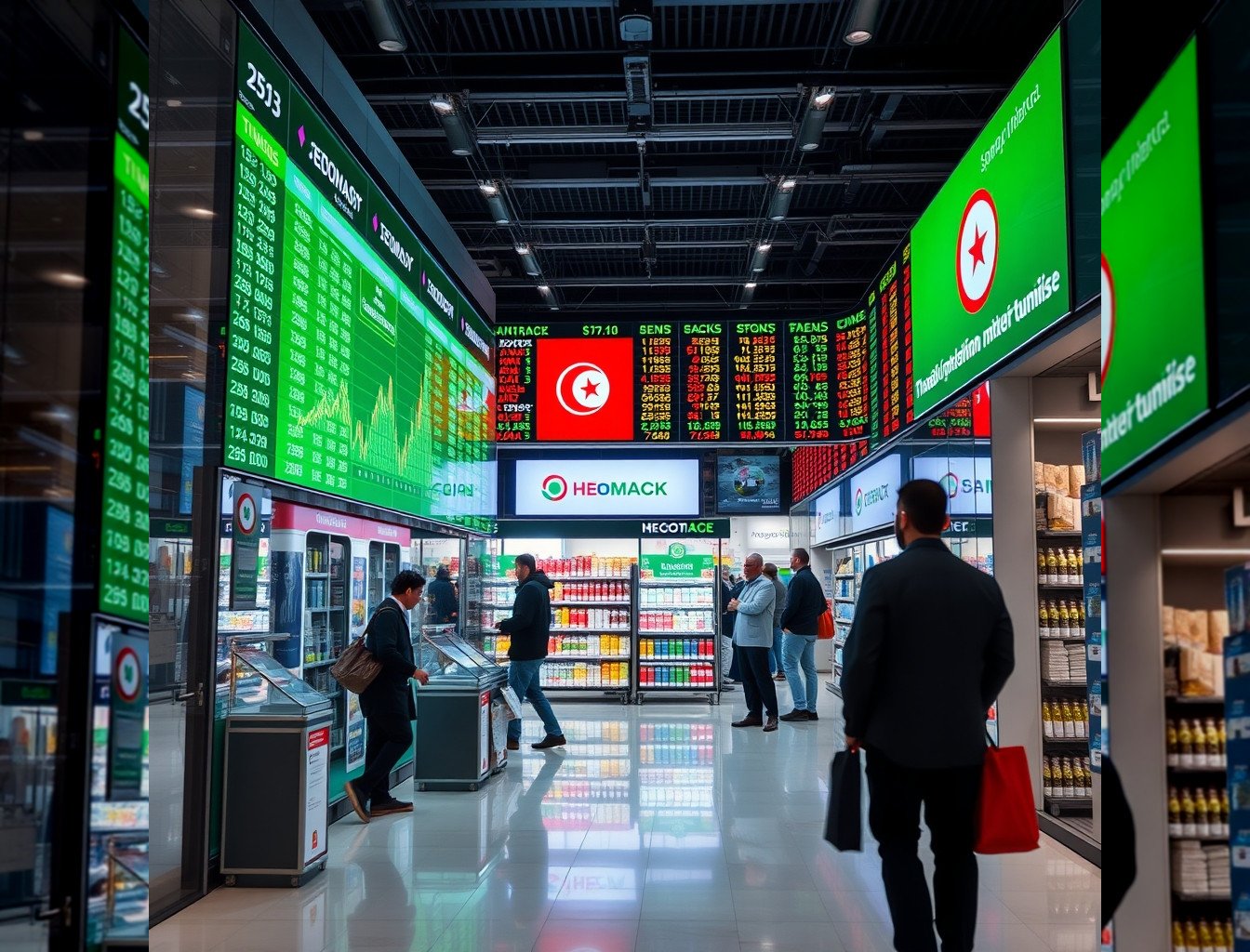
The Tunisian stock market closed Tuesday with a subdued performance, as the benchmark Tunindex slipped 0.20% to 19,082.15 points—despite a trading volume of 12.8 million dinars, well above average. The session was marked by three block transactions in SMART TUNISIE, totaling 3.4 million dinars, a figure that underscored its outsized role in the market. Yet the company’s share price remained practically flat at 34.450 dinars, signaling stagnation despite heavy institutional activity.
For entrepreneurs, this presents a paradox. SMART TUNISIE’s liquidity and trading volume reflect strong interest from fund managers and long-term investors. Its position as Tunisia’s leading IT distribution hub—supplying hardware, software, and cybersecurity solutions—makes it a critical player for digital-first businesses. However, its failure to gain ground amid a broader market decline suggests caution. Investors may be hedging against economic uncertainty, or the stock could be overvalued relative to its growth prospects.
The company’s resilience in IT distribution remains a strategic advantage. Tunisia’s digital economy, though nascent, is expanding, driven by remote work trends, government e-governance projects, and SME digitization. For Algerian entrepreneurs with tech-focused ventures—whether in cloud services, cybersecurity, or hardware supply—SMART TUNISIE could still serve as a gateway to Tunisian markets. Its supply chain infrastructure could facilitate cross-border partnerships, especially for firms seeking to bypass Algeria’s fragmented IT distribution landscape.
Retail and Industrial Gases Defy the Downturn—Opportunities for Algerian Exporters
While the broader market underperformed, two sectors bucked the trend: retail and industrial gases. MAGASIN GENERAL, Tunisia’s largest retail operator, surged 4.4% to 12.740 dinars, though on a modest trading volume of 64,000 dinars. The gain suggests consumer spending remains relatively robust, particularly in urban centers where the chain dominates.
For Algerian entrepreneurs, this could signal untapped potential in cross-border retail ventures. Tunisia’s franchise and e-commerce sectors are growing, but local players still face challenges in logistics, payment systems, and supply chain efficiency. Algerian firms with experience in franchise management, last-mile delivery, or digital payment integration could find entry points—whether through joint ventures or direct investments. MAGASIN GENERAL’s performance also highlights the resilience of discretionary spending, a trend that could benefit Algerian exporters of consumer goods, from electronics to textiles.
Meanwhile, Air Liquide’s 2.3% gain to 230 dinars reflected sustained demand for industrial gases—a cornerstone of manufacturing, healthcare, and energy sectors. The company’s strong showing aligns with Tunisia’s ongoing industrialization push, particularly in automotive, pharmaceuticals, and renewable energy. Algerian exporters of specialty gases, welding equipment, or industrial machinery could leverage this demand, especially if local suppliers struggle with supply constraints or high costs.
The contrast between SMART TUNISIE’s stagnation and these two sectors’ gains underscores Tunisia’s uneven economic recovery. While digital and industrial segments show promise, consumer-facing and wholesale sectors remain vulnerable—a dynamic Algerian investors must navigate carefully.
Wholesale and Automotive Stocks Plunge—Weaknesses That Could Be Opportunities
The market’s worst performers—SOTUMAG and STA—highlighted deeper structural challenges, but these weaknesses may also create entry points for Algerian businesses.
SOTUMAG, Tunisia’s wholesale market operator, collapsed 5.1% to 23.980 dinars, dragging 217,000 dinars in trading volume. The decline reflects long-standing inefficiencies in Tunisia’s wholesale sector: high transaction costs, outdated infrastructure, and bureaucratic hurdles. For Algerian logistics firms, agri-food exporters, or cold-chain operators, this could mean opportunities to modernize supply chains. Tunisia’s agricultural and textile exports often face bottlenecks at wholesale markets—areas where Algerian players with leaner, tech-driven models could disrupt the status quo.
Similarly, STA’s 4.1% drop to 109.290 dinars signaled weakness in Tunisia’s automotive sector, a traditional economic pillar. The decline may stem from slower vehicle sales, post-pandemic demand normalization, or competition from used imports. Yet this very weakness could benefit Algerian automotive suppliers. Tunisia’s EV transition is accelerating, but local assembly plants still lack domestic battery or component manufacturers. Algerian firms with EV battery technology, electric motor expertise, or lightweight materials could fill this gap, either through local partnerships or direct investment.
The volatility in these sectors may deter risk-averse investors, but for Algerian entrepreneurs with niche expertise, it presents strategic inroads. The key lies in identifying where Tunisia’s weaknesses align with Algeria’s strengths—whether in logistics efficiency, industrial gas supply, or automotive innovation.
Key Takeaway for Entrepreneurs
The Tunisian stock market’s mixed signals offer both caution and opportunity for Algerian investors. SMART TUNISIE’s dominance confirms the digital economy’s importance, while retail and industrial gas stocks reveal resilient demand in specific sectors. Conversely, wholesale and automotive struggles expose structural gaps where Algerian firms—particularly those in logistics, agri-food, or EV components—could gain a foothold.
The lesson is clear: Tunisia’s market is not collapsing, but it is fragmenting. Success will depend on targeted entry points, whether through strategic partnerships, supply chain optimization, or filling industrial gaps. For Algerian entrepreneurs, the time to act is now—before local players consolidate their positions.“`
Sources
💡 Starting a business in Algeria? GlobalStart guides you step by step: procedures, real costs, company forms (SARL, EURL, SPA) and CNRC registration.