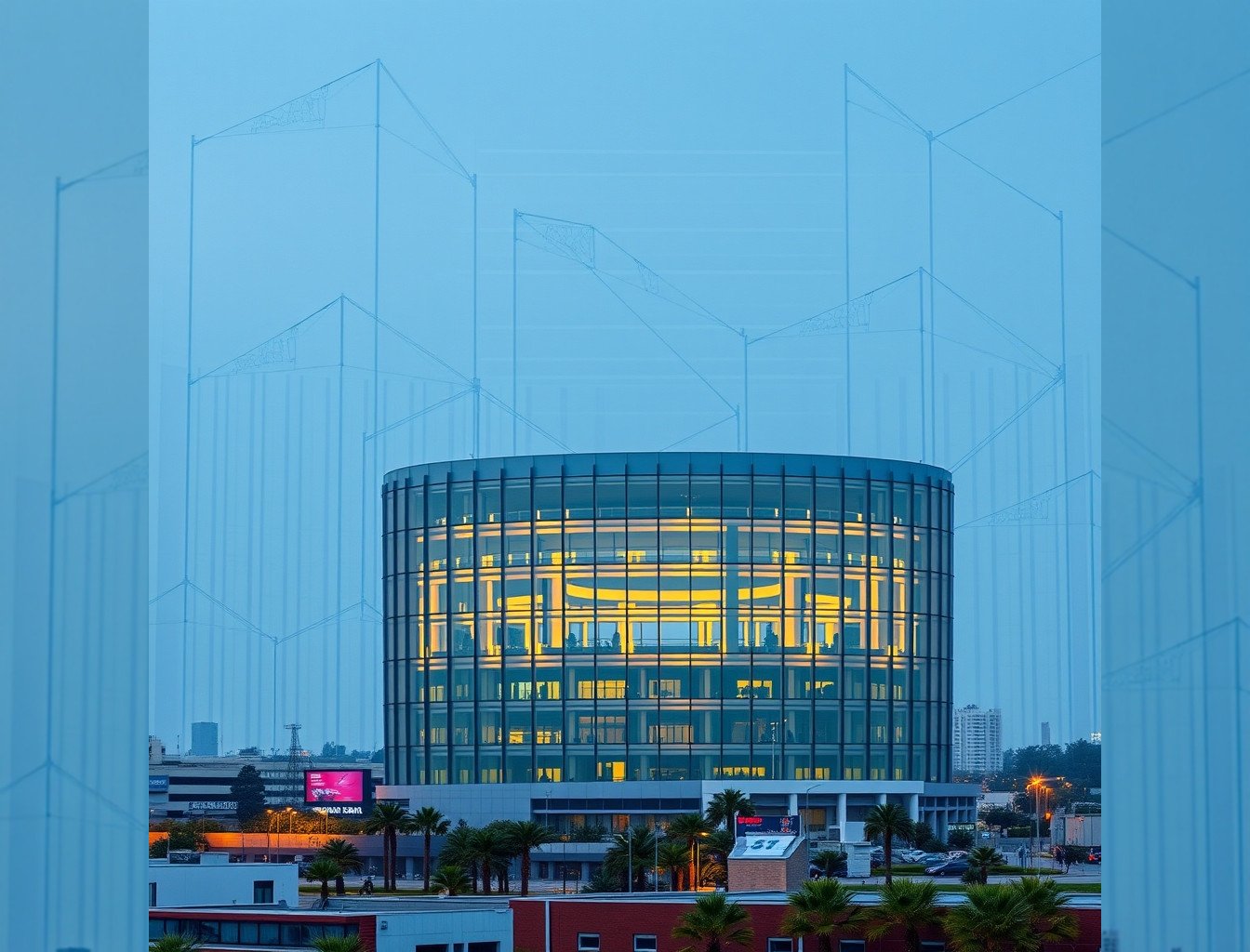
Algeria’s premier computing research institute, CERIST, opened a 5,000 m² Deeptech Innovation Hub in Algiers this week to turn academic prototypes into scalable AI and cybersecurity startups. The facility is the first of its kind financed entirely by the state and is designed to bridge the 12-to-18-month “valley of death” that kills promising Algerian research before it reaches market. CERIST will host 60 resident teams and run a €12 million proof-of-concept fund backed by the Ministry of Higher Education’s 2025 innovation budget.
Anchor tenants are already in place: a team from Blida University refining an Arabic-language cybersecurity firewall and a Boumerdès Polytechnic spin-off building low-power edge-AI chips for oilfield sensors. “We will co-develop with them until they have a minimum viable product and a clear go-to-market channel,” said Dr Amina Djemai, CERIST’s director-general, speaking to reporters at the ribbon-cutting. The hub also offers shared wet-lab space for prototype testing and access to Algeria’s only Tier-3 data centre run by Algeria Telecom.
Funding taps new sources
CERIST’s proof-of-concept fund is carved from the €50 million Algerian Startup Fund announced in 2025 by President Tebboune. Unlike previous state-backed credit lines, this tranche is non-repayable for teams that convert a validated prototype into a registered startup within 18 months. “Gone are the days when a PhD student had to wait for a bank loan to prove traction,” explained Djemai. “We are putting risk capital on the table at seed level, which is rare in Algeria.”
The hub sits inside the Technopole d’Alger, a 35-hectare science park where Algeria’s national oil company SONATRACH already leases a 4,000 m² R&D wing for digital subsurface modelling. SONATRACH’s chief digital officer, Kamel Benmabrouk, told local press that the company will co-sponsor two resident teams working on predictive maintenance algorithms for gas turbines. “We need scalable AI solutions that can run on our existing infrastructure,” he said. “This hub gives us direct access to the best local talent.”
Cybersecurity demand surges
Algeria’s 2025 national cybersecurity strategy mandates that 30 % of government data centres migrate to sovereign clouds within 24 months. That requirement has created an immediate market for SMEs able to deliver hardened AI-driven security stacks. CERIST’s first call for residency in May 2026 yielded 412 applications, of which 62 % came from diaspora engineers—mostly from France and Canada—who now see a clear path to return.
One applicant is Dr Yacine Zerrouki, a former Thales cybersecurity architect who left Algiers in 2018. “I spent two years pitching French VCs with no traction,” he said over a video call from Montreal last week. “Back home, the state is finally underwriting the risk I was asking them to take. I’m moving my family and my startup to Algiers next quarter.” CERIST offers subsidised housing and tax holidays for returning founders under the 2025 Startup Act.
Infrastructure gaps remain
Despite the hub’s launch, entrepreneurs still face real constraints. Internet speeds in Algiers average 12 Mbps and power outages reach 47 hours per quarter in some industrial suburbs. “Our edge-AI chips overheat when voltage dips,” admitted Nassim Berrabah, CEO of the Boumerdès spin-off. “We are installing local battery backups, but it adds 18 % to our bill of materials.” CERIST plans to install a micro-grid with 1 MW of solar plus 2 MWh of battery storage by late 2026, funded by a €3 million grant from the African Development Bank.
Diaspora investors eye opportunities
Algerian diaspora networks have already pledged €8 million in follow-on seed capital through the Algiers Deeptech Angels club launched in January 2026. Club president Leila Ferhani, a fintech investor based in Dubai, told Reuters that members are especially interested in cybersecurity and green-tech startups. “We see the hub as a deal-flow engine,” she said. “Once a resident team secures the proof-of-concept grant, our members can write cheques up to €500 k without leaving the GCC.”
Regulatory clarity improves
The 2025 Startup Act streamlined company registration to 72 hours and introduced a 5 % flat corporate tax for the first five years for startups registered in technopoles. However, foreign direct investment into Algerian startups remains capped at 49 % unless the startup is classified as “strategic” by the Ministry of Knowledge Economy. Dr Djemai confirmed that all resident teams at CERIST will automatically qualify for the 49 % FDI ceiling, easing diaspora participation.
Key takeaway for entrepreneurs
The CERIST Deeptech Innovation Hub provides non-repayable proof-of-concept grants up to €200 k, subsidised space and Tier-3 data-centre access. Diaspora founders can register remotely under the 2025 Startup Act and benefit from 5 % tax for five years. Infrastructure constraints persist, so plan for micro-grid and backup power in your budget.
Sources
- iAfrica.com
- We are Tech
- TechAfrica News
- Launch Base Africa
💡 Starting a business in Algeria? GlobalStart guides you step by step: procedures, real costs, company forms (SARL, EURL, SPA) and CNRC registration.